
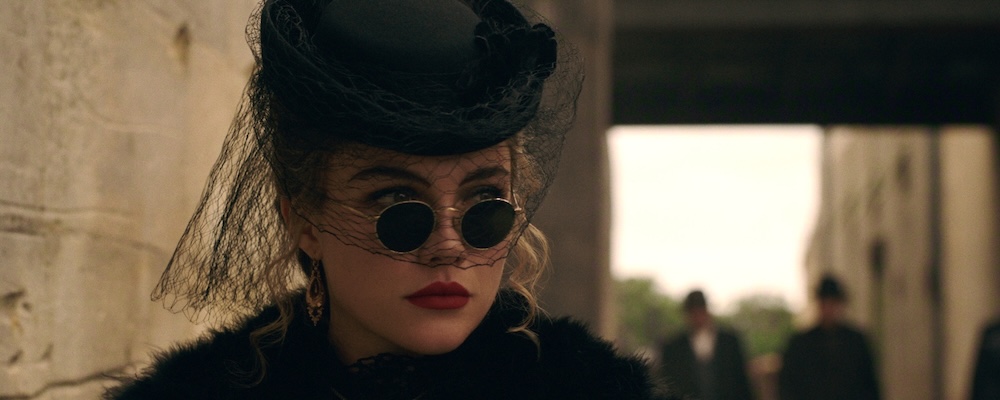
Florence Pugh Is the Dark Heart and Soul of Zoe Kazan’s Grandiose ‘East of Eden’ Adaptation
Alci Rengifo
Some productions can really be elevated by a key excellent performance. Netflix’s “East of Eden” arrives with plenty of material to build hype from various angles. It is based on the classic novel by John Steinbeck. Its showrunner is Zoe Kazan, granddaughter of the late Elia Kazan who directed the classic 1955 adaptation starring James Dean. Despite generally maintaining much respect, the Kazan film has also been criticized by readers of the novel for focusing primarily on its final sections. It’s such a sweeping narrative that it is easy to see why in the ‘50s, it made sense to narrow it down. The younger Kazan’s grandiose, seven-part adaptation tries to cover at least the essentials, revising some of it to fit contemporary sensibilities. Though far from perfect, this “East of Eden” keeps an engaging pace that gets better when Florence Pugh comes into frame.
Steinbeck’s novel famously took open inspiration from the Bible, in particular the passages in Genesis concerning the story of Cain and Abel. This spirit is still in the Netflix version, opening in late 1800s Connecticut. Two half-brothers, Adam (Christopher Abbott) and Charles (Mike Faist) are raised under the domineering presence of their father, Cyrus (Tracy Letts), a Civil War veteran. Well, more like a self-aggrandizing hero who claims to have been present at Gettysburg. Adam is the kinder, more inquisitive son while Charles has a darker edge. Cyrus has a strange view of tough love, making Adam enlist because he loves him as a favorite. Years later and Cyrus dies, leaving the brothers to grapple with building their lives as opposites. They also discover something shocking about Cyrus that upends their idea of everything they thought they knew growing up. Fate truly upends their world when a bloodied, beaten woman crawls to their doorstep. This is Cathy Ames (Pugh), the woman who will define the course of the brothers’ lives, especially Adam.
There are reviewers already calling this “East of Eden” a corrective to the 1955 film. Here a cinema scholar should raise their arm and defend how Elia Kazan’s work endures on its own as a film, full of intense images and an aching performance by James Dean. It also tackled well some of the complexities boiling in the subtext of Steinbeck’s tale, like how our flaws can come out of our strengths, even in the most strictly ethical people. The new “East of Eden” actually takes some time to get cooking, with its first two episodes dealing solely with the meandering origins of Adam and Charles. Abbott and Faist are fine actors but they fail to show off much range, also due to some rather simplistic writing that seems to adhere to Netflix’s aim of dumbing down content for viewers. Too many spell everything out instead of letting performance get it across. Directors Garth Davis and Laure de Clermont-Tonnerre are efficient with the pacing but achieve a visual look that is just part of a now standard Netflix palette for period shows. The colors don’t pop and the twilights feel so drained.
When Pugh’s Cathy arrives then the show becomes much more engaging. The character is one of Steinbeck’s most famous and hardest to decipher. Not necessarily evil, but coldly selfish, in the ’55 version she becomes the portrait of someone who should never take on the responsibility of parenthood (not as a cheap judgement, but as an observation). Kazan’s take on Cathy is more feminist in a sense, at least by expanding on the story to try and provide a richer psychological profile. In other words, what turns in life made Cathy into the sharp but cunning brothel madam of later years? The second episode begins a biographical journey going back to Cathy’s childhood when she is first seduced by a local boy, then a school teacher. Men see her as an object, to the point of obsession. Realizing the power using her body can give, Cathy is soon looking for work at a brothel where the owner prefers to make her his mistress. He too is then wrecked by jealousy. As a woman in a male-dominated society, the writing seems to say, Cathy’s environment leads to her eventual amorality. In the present, naïve Adam offers to marry her, taking on a savior complex. Before long, she’s seducing Charles.
The story eventually moves to the Salinas Valley in California, the state that defined so much of Steinbeck’s best work. For some viewers this is when the story enters the more familiar territory for those who have only seen the movie. Kazan and team do manage to make the narrative feel fresh again, despite the series’ insistent flaws. Lesser known characters are included such as Samuel Hamilton (Ciarán Hinds), the eternally unlucky man who helps Adam find a gorgeous plot of land to build a home. Manservant Lee (Lee) is also introduced with intelligence and the wisdom one gathers through life’s journey. It is also in the Salinas Valley where Adam and Cathy’s legacy climaxes in the form of their own sons, Cal (Joseph Zada) and Aron (Joe Anders), as well as the woman who comes between them, Abra (Zoe Phillips). At times it all verges on soapy melodrama, but because of the earlier episodes, we can see the epic arc of a family history. Cathy is too restless to ever be tied down and Adam was trying to conjure a domestic life she never wanted. It would be easier to resolve without offspring, but the sons will have to deal with the real consequences of their parents’ choices. It all comes back to Pugh, who beneath a hard exterior evokes a woman so scarred that tenderness fails alien to her. Pugh towers over everyone else with a performance that comes closest to tapping into the Biblical furies of the source material.
“East of Eden” begins streaming Oct. 1 on Netflix.