
‘Carrie’: Mike Flanagan Updates Stephen King Classic Into an Unnerving Look at Youth in the Age of Social Media
Alci Rengifo
Some literary purists may scoff, but the better works of Stephen King are by now true American standards. Mike Flanagan’s new limited series adaptation of “Carrie” is the third version of the novel that made the author’s name, and the second TV incarnation. Brian De Palma’s iconic 1976 adaptation starring Sissy Spacek endures as a universal horror fable, at its core about the cruelties of youth. Generations, trends and sensibilities shift, but being a teenager will never be easy. Social media has only made it harder and this “Carrie” is smart in updating the story for an era where any mistake, any gripe, can be posted for the world to see. The execution is not flawless, though always engaging.
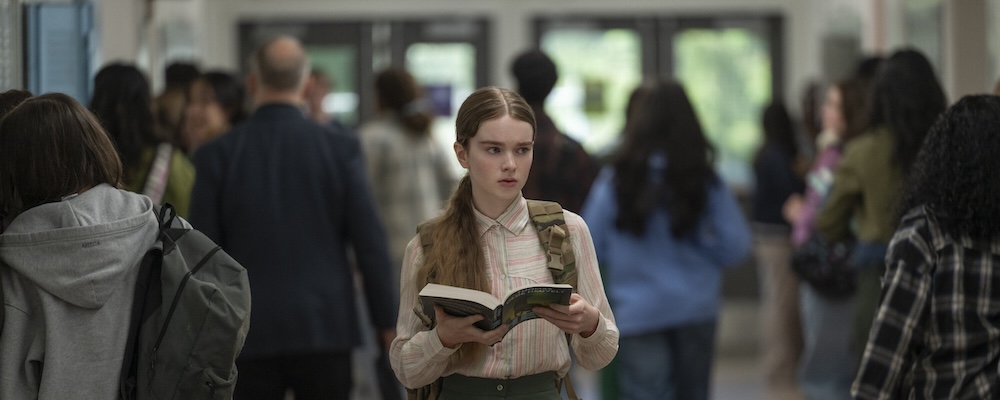
The series opens with hints of the famous apocalyptic ending, with footage and audio of 911 calls and news footage of the town of Chamberlain in flames. The narrative pulls back a bit to the tragic death of construction worker Ralph White (Tahmoh Penikett), crushed under a pile of rubble. Ralph leaves behind an ultra-religious wife, Margaret (Samantha Sloyan), and teen daughter, Carrie (Summer H. Howell). In order to keep custody of her daughter and the house, Margaret must find work, the only option being a big box store. Up to now, Carrie has only been strictly home-schooled. The bright but sheltered girl must now attend Ewen High School. Carrie is instantly taken aback by the clique-based ecosystem. Sue Snell (Siena Agudong), the class president, seems nice enough. Too bad her best friend is Christine (Alison Thornton), a spoiled mean girl dealing with a lawyer father, John (Michael Trucco), resentful over his divorce and desperate to hide financial losses. When Carrie has her first period during gym class and everyone takes video, Christine decides to make an anonymous Instagram page to post the footage, then expanding it into an overall place for gossip.
The original “Carrie” novel is rather small (for a Stephen King book) which helped the De Palma film work as a tight, riveting feature. That Flanagan would eventually make his way to this material should come as no surprise, since more than any other modern filmmaker he has been adapting King, including “Doctor Sleep” and the wonderful yet underrated “The Life of Chuck.” For television the challenge is in how to expand the material. Characters that are almost footnotes now get entire storylines to themselves. Their updating is still convincing enough for 2026. Principal Henry Grayle (Matthew Lillard, in a nice nod to past horror franchises) cares for the students but has to be watchful in a world where parents can easily sue. Peter Morton (Tim Bagley), the guidance counselor, is openly gay and sensitive to Carrie being an outsider. Gym teacher Rita (Amber Midthunder) is the younger faculty and starts a relationship with slightly older teacher Mr. Peist (Rahul Kohli). Instead of being portrayed as adult caricatures, the faculty lack malice. It’s the parents who are the more unnerving authority figures. One only feels sympathy for Heather Graham’s Mrs. Hargensen, Christine’s mother, who admits her daughter is practically a monster.
“Carrie” as a whole is not really a “horror” series. It has scares and tension, but becomes most unnerving when the teens act out mindless cruelties. The infamous moment from the story, when Carrie has her first period and panics, since Margaret never taught her about such biological matters, captures the terror of living in a generation where every act can be recorded. Christine uses the moment to launch an Instagram page that only helps fuel gossip and bullying on campus, eventually affecting the lives of the teachers who become targets of the anonymous posts. Here is also where the material becomes more social commentary than spooks. Margaret is not the total recluse of the original tale, instead taking advantage of Carrie’s plight to launch her own social media page to attack Christine and the sinful values of the community. In flashbacks we also learn that her late husband Ralph was a classic Midwestern archetype of the conspiracy culture dominating the MAGA movement. He instructed Margaret on how to become paranoid about government conspiracies and secret experiments. When Margaret forces Carrie into a “prayer closet” for punishment, she’s doing it like a contemporary evangelical desperate to close her daughter off from the lustful ways of the world.
Flanagan’s approach may not quite work as horror, but as a teen series, his “Carrie” feels compulsively watchable. Summer H. Howell hits all the right notes as Carrie, not trying to ever imitate Sissy Spacek or other past performances. Her Carrie is not an introvert but too open and nice, excited to take in a world at public school she has never known before. She’s the archetype of a sheltered kid who isn’t afraid of new people but is too naïve to realize not everyone wants to be her friend. The other teens are written with expected problems but handled maturely, like pregnancy scares. Alison Thornton is a convincingly intimidating brat who hooks up with a notorious guy who was expelled, Billy Nolan (Arthur Conti). In the De Palma movie, this latter role was played by John Travolta as a brainless bad boyfriend. Conti turns Nolan into a sociopath taking advantage of Christine’s frustrations. He’s more than a mere acolyte, particularly in chilling scenes where he throws bricks onto incoming traffic to excite an astounded, slightly younger Christine. They meet in one of those parties that seems inspired by “Euphoria,” where innocent Carrie looks puzzled when Christine mentions there are “hook up rooms” upstairs.
The one major flaw in the writing is a needless addition of another storyline to the plot involving a secret society of psychic young people who become alert to Carrie’s presence. It is enough to have the nervous young girl realize she has these gifts, only briskly using them since Margaret is clearly terrified of her offspring’s abilities. There is no need to add extra characters who do nothing for most of the eight episodes, except barely appear at the end to provide a disappointing extra layer to the famous prom massacre. Carrie doesn’t need a telekinetic bestie to egg her on to use her powers to silence Christine. The emotional impact of King’s story is that Carrie is a genuinely nice person pushed to an extreme by a dumb society. Flanagan seems to be trying to connect with other corners of the King universe, such as the novel “Firestarter.” Even worse, the closing scene hints at a second season. For fans it may be fun, but it serves the story no purpose. When that bucket of blood falls on Carrie at the prom, we feel her shock, hurt and disappointment. The series succeeds well enough in capturing how now such a humiliation becomes fuel for dangerous rages because those laughing faces are also pointing their cell phones.
“Carrie” begins streaming Oct. 7 on Prime Video.