
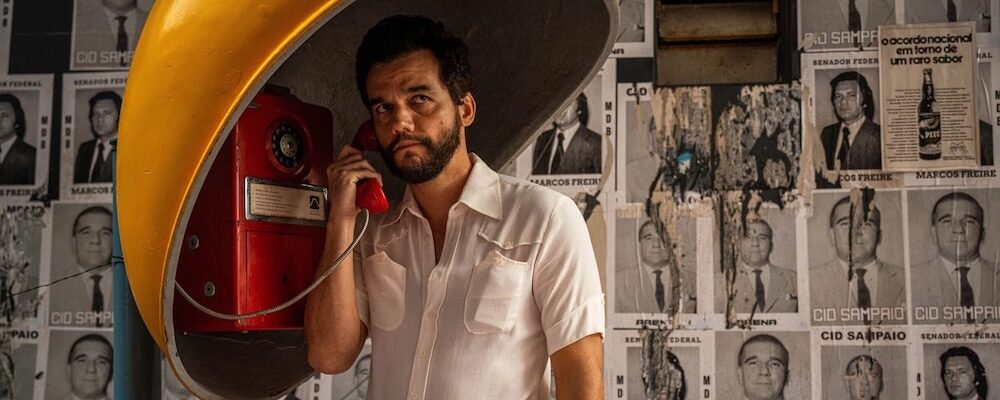
‘The Secret Agent’: Wagner Moura Is a Man on the Run in Kleber Mendonça Filho’s Rich Evocation of Brazil’s Recent Past
Alci Rengifo
The films of Brazilian director Kleber Mendonça Filho are driven by a rich sense of place and time. His stories occupy a space so fully that they truly feel recovered from some distant decade. His country’s modern history is a clear obsession, no matter the plot, and it comes across in the construction of every new work. Filho’s “The Secret Agent” features a title that is almost a tease. It seems to promise some kind of vintage espionage thriller. Instead, Filho is defining the environment of Brazil in 1977 through the plight of a man indeed living in the underground, but never operating in familiar thriller clichés. “The Secret Agent” made an impact at the Cannes Film Festival, where it won Best Director, Best Actor and the FIPRESCI Prize. Wonderfully crafted, this is an absorbing portrait of people and lives under the shadow of a multifaceted tyranny.
The plot opens with a man in a VW, Marcelo (Wagner Moura), driving into an arid gas station in the middle of nowhere. A dead body lies under the blazing sun but the gas station owner tells him not to worry, it’s just a dead robber. The cops are too busy with Carnival to come deal with the corpse. However, the police do arrive and inspect Marcelo’s car for anything suspicious. When they find nothing, he just needs to contribute to the “police fund” so he can get back on the road to the city of Recife. This is a man clearly on the run, operating a new identity. In Recife, he links up with Dona Sebastiana (Tânia Maria), an aged leftist watching over a network of various dissidents, even immigrants from civil war-torn Angola. Marcelo needs fake IDs for himself and his young son Fernando (Enzo Nunes), currently being cared for by Marcelo’s father-in-law, Alexandre (Carlos Francisco). Marcelo also seeks certain information at the local public records. He needs to move fast since a corrupt Sao Paolo industrialist, Henrique Ghirotti (Luciano Chirolli), has sent hitmen to track down the former university researcher turned fugitive.
Much of South American cinema remains haunted by the region’s history during the Cold War, when U.S.-backed military regimes ruled various countries and sought to crush revolutionary movements. Last year Brazil won the Best International Film Oscar for Walter Salles’ “I’m Still Here,” about a dissident’s disappearance and what it did to his family. Filho also comments on the era of the dictatorship but with subtle details. The culture of the period is evident in the small details, like a busload of office workers arriving at the local archives with only military music allowed to play on the radio. The group that gathers around Dona Sebastiana does not spend its time just espousing radical politics, but sharing personal concerns and fears about how to protect their loved ones. It is soon apparent that Marcelo’s wife was murdered by Ghirotti, but his is a controlled anger, simmering. Filho’s casting is so meticulous that even office workers have the expression of people simply toiling under a system that leaves you alone if you just ignore it. The two hitmen sent by Ghirotti, Augusto (Roney Villela) and Bobby (Gabriel Leone), also look brilliantly like washouts from the dregs of society, willing to do anything for good pay.
Instead of rushing the narrative in the style of an action movie, Filho envelops the audience in moments that generate a particular kind of tension. Augusto and Bobby driving down a dark road, with Donna Summers’ Donna Summer’s “Love To Love You Baby” playing on their car radio, feels so much more ominous and threatening. The cinematography by Evgenia Alexandrova is rich and saturated, evoking classic ‘70s thrillers. Filho uses Carnival to provide an ironic, festive mood in the city. While the locals dance and drink, Marcelo has to disappear into a crowd to avoid certain death from his pursuers. Sequences like a chase are used to tour us through the larger and small corners of Recife. All of these elements are used to eventually form a layered portrait of both Marcelo’s world and Brazil as it was at the time. These are microcosmic lives making it through this moment in history. Flashbacks reveal how Marcelo angered Ghirotti over ownership of a patent, which the industrialist coveted after having public funding pulled for the university where Marcelo worked. What else could the researcher do? The big capitalists were in league with the military regime. This is a world where there are no courts or authorities to seek help from.
A former film critic, Filho infuses all his films with a genuine love for cinema and its history. His main character in the acclaimed 2016 film “Aquarius” is a veteran music critic standing against developers trying to shove her out of her apartment. Here he lovingly includes touches like Marcelo and Alexandre meeting in an old movie theater where audiences are streaming in to see “The Omen.” Particular shots and zooms nod at directors like Costa-Gavras and Alan J. Pakula. He then plays with time, switching from a conversation to a taped recording of that same exchange being listened to by a young researcher in the present, Flavia (Laura Lufesi). She will find answers to questions posed nearly five decades ago. It is a masterful way of providing an even richer subtext, which is that history, whether grand or personal, has a way of rarely disappearing. Brazil today is still grappling with a battle against fascist forces, like most of the world. A director like Filho remains obsessed with the past because it never goes away. Marcelo’s fate echoes down the years like a nation’s buried scars that eventually demand a reckoning.
“The Secret Agent” releases Nov. 26 in New York and Dec. 5 in Los Angeles with a national expansion to follow.