
‘Hamnet’: Filmmaker Chloé Zhao on Exploring the Universality of Sorrow in Ethereal Adaptation of Maggie O’Farrell’s Acclaimed Novel
Alci Rengifo
Chloé Zhao is a filmmaker with a particularly special cinematic language. She can capture stark experiences with an almost ethereal glow. In 2020, the Bejing-born director made history by becoming the first woman of color to win the Oscar for Best Director for “Nomadland,” a piercing portrait of an American woman living on the road after the Great Recession overturned her life. Before “Nomadland,” Zhao had garnered festival attention with “The Rider,” an eloquent film full of magic hour images about an injured rodeo star. After her Oscar win, Marvel came calling and Zhao brought her lyrical touch to “Eternals.” Her unique voice made her a natural match for “Hamnet,” an emotionally shattering adaptation of the acclaimed 2020 novel by Maggie O’Farrell, which won the National Book Critics Circle Award for Fiction. It is a triumphant return for Zhao to a more intimate form of storytelling.
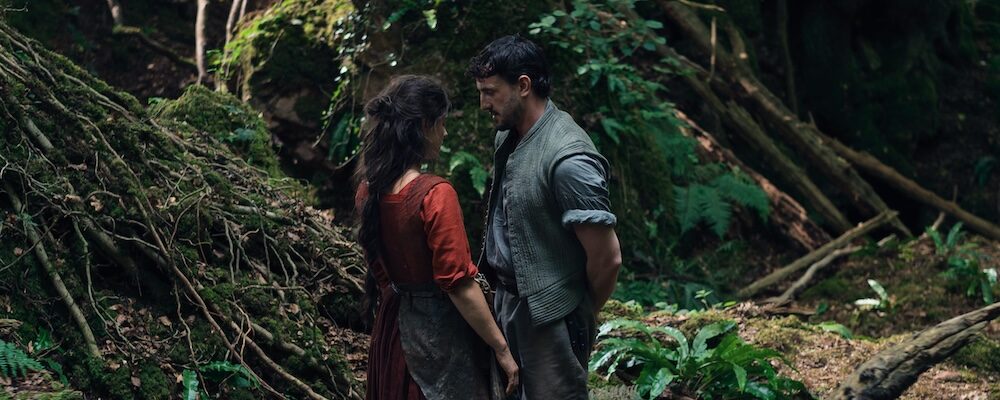
The book’s premise is taken from a vague but potent bit of history. The iconic playwright William Shakespeare and his wife had an 11-year-old son named Hamnet, who died in 1596 under circumstances still unclear. Scholars have long suspected that Shakespeare’s most famous play, “Hamlet,” was surely inspired in part by this loss. At the time the names Hamnet and Hamlet were considered to be the same. It is a wonderful starting point for the story Zhao brings to life so luminously, featuring Jessie Buckley in a searing performance as Agnes, the enigmatic woman who marries a young Will Shakespeare (Paul Mescal). This is a film about love and loss, capturing how both are so delicate and powerful. Shakespeare as a historical giant dissipates behind this portrait of a devoted marriage rocked by a terrible loss when young Hamnet (Jacobi Jupe) falls ill with plague.
“Those emotions and capacities are within every one of us,” Zhao tells Entertainment Voice when discussing the making of “Hamnet.” Beyond making a period piece about a historical figure, Zhao wanted to capture the universality of very human emotions. “What Paul and Jessie have inside of them was my North Star. I am not looking at historical interpretations. My truth that is being captured is in the moments with these actors.” Zhao describes the process as getting the actors to be “in their bodies as much as possible.” Indeed, Buckley and Mescal inhabit their characters fully as flesh and blood human beings with no historical foresight. This Shakespeare is a frustrated young artist writing at night by candlelight. Agnes is a woman connected to nature, finding herself powerless when the plague strikes her son. Buckley is so piercing when expressing loss that surely she will be mentioned often, possibly along with Mescal, when awards and nominations begin rolling out.
When doing a period piece, one imagines the filmmaker obsessively pouring over the era. Zhao is an impressive team player who ventures into the world of the story hand in hand with her collaborators. “I didn’t immerse myself in Shakespeare’s world,” she says, “I did go visit Stratford while my heads of departments did immerse themselves. Maggie O’Farrell has already done it and so did the actors.” Zhao co-wrote the screenplay with O’Farrell, who in the book evokes the London of the 1500s so well that you can smell the mud. A wonderful element of the novel the film preserves is the idea of Shakespeare brought down to human size. When Hamnet dies, Will deals with his pain by running back to London, using his commitments to the theater as an excuse. It is dramatic speculation that feels so plausible. Like many great artists, the most famous of all playwrights was merely human. “Maggie had said to me at the beginning that all of the historical illustrations and paintings that we have of Shakespeare had been done after he died,” says Zhao, “so, many projections and interpretations have accumulated for a long time. Other than the plays that he left behind, we could pretty much interpret the story however we want.”
Some directors have a strict approach to the visual language of their projects. Martin Scorsese, for example, delivers a meticulous shot list to his cinematographer. Zhao works both ways. For “Hamnet,” she achieved its ethereal, baroque look, where nature functions as a living entity in the story, by trusting cinematographer Łukasz Żal. “I put a lot of trust in my cinematographer. I believe in a good balance of chaos and order. I always thrive to have that balance. I did storyboard when I did ‘Eternals.’ I storyboarded meticulously for that film.” For “Hamnet” the freer approach comes across in its intimate style where Zhao rarely goes for overly grand gestures. This is a film where pain can be brutally silent and homes feel empty after a sudden death. Its “biggest” moment comes at the end, when Agnes makes her way to Globe Theatre in London to see for herself this “Hamlet” play her husband has written, filled with rage at the idea that her son’s name is now some prop. “There are scenes where we went in without any plans,” says Zhao, “at the Globe Theatre I would come in every morning with a map showing where all the people are going to be, where the cameras will be, and what the shot list is and in what order I think it should be shot.” For Zhao, directing, like human emotions, thrives on being measured and unpredictable. “It depends on what the scene asks for, but it is not true that you should just have chaos and free flow. Order is also very important.”
“Hamnet” releases Nov. 26 in select theaters and expands Dec. 5 in theaters nationwide.