
‘The Testament of Ann Lee’: Amanda Seyfried Is Extraordinary in Mona Fastvold’s Singular Shaker Musical
Sandra Miska
The spirit of the aberrant woman behind the religious sect known as the Shakers inhabits Amanda Seyfried in “The Testament of Ann Lee.” Directed by Mona Fastvold and co-written by Brady Corbet (the partners behind “The Brutalist”), this musical drama traces Lee’s extraordinary life, from her humble roots in Manchester, England to her time in Colonial America, where this unlikely female preacher ignites a fervent religious movement.
Ann’s story is narrated by a woman named Mary (the always fantastic Thomasin McKenzie), who knows that for us to best understand the woman she comes to follow, she has to start at the beginning. Born in 1736, the second of eight children in the family of a blacksmith, Ann (played by Esmee Hewett and Millie Rose Crossley as a child), as we see here, had a conventional childhood for a woman of her background. She receives no formal education, and is instead put to work as a child alongside her mother at a textile mill. Later, she takes a job as a cook at a mental hospital. As was common practice for a lower-income family of that time, young Ann slept in the same room as her siblings and parents, meaning she could see her mother and father having sex, which sets in motion what eventually becomes her total aversion to the act. She shares an unbreakable bond with her brother William (Lewis Pullman, Benjamin Bagota and Harry Conway as a child), who becomes her lifelong devotee and supporter.
Life is mostly centered around church and religion during this period in England, and this is especially the case for Ann. As a young woman, she is attracted to a Quaker group headed up by an unconventional married couple, Jane (Stacey Martin) and James Wardley (Scott Handy). She goes on to marry Abraham (a superb Christopher Abbott), with whom she has four children in quick succession, with each one dying in infancy. After her last child dies at birth, she has some sort of postpartum mental breakdown that lands her in the same hospital where she was once employed. There, she refuses nourishment and eventually has a vision. Following her release, she reveals to her closest Quaker associates that God has revealed to her that one must forsake sexual intimacy to be closest to him. Her newfound beliefs eventually lead to her setting sail to America to recruit more followers, and with her goes a small group that includes William, Abraham and Mary, as well as her niece Nancy (Viola Prettejohn).
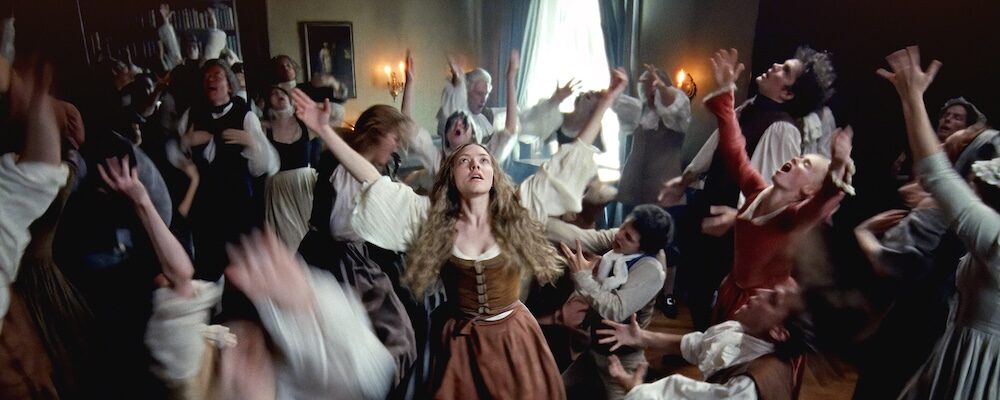
In America, Ann faces her biggest challenges, including losing followers who it turns out are not really keen on celibacy. She also deals with persecution, as well as the dangers caused by the Revolutionary War. Musical numbers are woven throughout the film, and while some work better and seem more natural than others, they mostly serve to break up tension, express deep emotions, and show the Shakers’ charismatic form of worship. The songs themselves, composed by Daniel Blumberg, are drawn from original Shaker hymns.
Seyfried fully commits here, delivering a transformative, career-high performance. No matter what one thinks of Ann or her beliefs, one cannot help by admire her for her determination, bravery, and commitment to equality. Upon her arrival in America, she shows great courage when she publicly shames those participating in a slave auction. Seyfried, Fastvold and Corbet give plenty of room for the viewer to come to their own conclusions about Ann. The case is certainly made that her extreme views regarding sex are the result of the trauma she endures in her life, but that does not necessarily negate her religious beliefs. It would be easy to write off the Shakers as a crazy group of fanatics, but they mostly come across as sympathetic here. The young mother of seven who suffers from severe postpartum depression especially stands out.
While “The Testament of Ann Lee” tells a captivating story, it is a tad overlong; perhaps a few musical numbers could have been shortened or taken out altogether. The scenes of Shakers engaged in woodworking are not particularly exciting, but they are shot beautifully and show how the sect became known for their great craftsmanship. And while Seyfried is great, it still feels like there is some missed opportunity to dive deeper into other characters, such as Abraham, Mary and William. The latter is an especially intriguing character due to his intense devotion to his sister and the fact that he is gay, something that is glossed over. But this is Ann’s story, and we are with her until the wistful end.
“The Testament of Ann Lee” releases Dec. 25 in New York and Los Angeles, Jan. 16 in select theaters.