
‘The Choral’: A Determined Ralph Fiennes Leads a WWI Village Choir in Gently Poignant British Drama
Sandra Miska
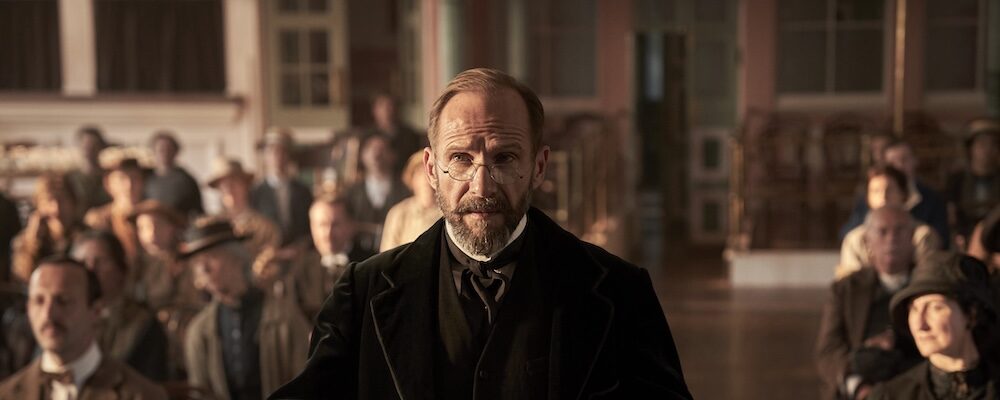
A group of villagers in a fictional Yorkshire town attempt to hold on to their humanity and reclaim some sense of normality through music during World War I in “The Choral,” the latest collaboration between writer Alan Bennett and director Nicholas Hytner. Ralph Fiennes gives a standout performance as Dr. Henry Guthrie, the new choirmaster hired by the choral society leaders, Alderman Duxbury (Roger Allam) and photographer Joe Flytton (Mark Addy), to take over the local choral society after the man who previously held that position is drafted. From the start, Henry has his work cut out for him. Not only is he tasked with putting together the choir’s annual production with limited men and resources, he also is faced with prejudicial attitudes from those in the village who disapprove of him due to his outsider status. Guthrie spent years living in Germany, the country England is now at war with. He also gets pushback for being an atheist and for favoring German composers; even those who have been dead for over a century are considered guilty by association.
There are disapproving whispers about the new choirmaster’s sexuality. Although it is never explicitly stated, Henry is gay, and a man dear to him is currently away fighting. The truth is, nearly everyone in the village is hurting due to the war, as most families have a loved one in the military or have already experienced loss. Even those who have not been directly impacted wait around with bated breath, especially the 17-year-old boys who know they will be called up as soon as they turn 18. As one may remember from history class, World War I began with much patriotism and fanfare, and was not expected to last more than a few months. Now, it is 1916, two years in, and Bennett and Hytner do an excellent job of honing in on that downtrodden, but not quite hopeless feeling felt on the homefront during this period.
War tends to break down class barriers, and the choir is no exception. With so many men away, Henry not only has to scale down the annual production, but he also has to get creative when it comes to scouting talent, even at the risk of causing a few of the fancy older ladies to clutch their pearls. Newcomers include a few of the aforementioned not-quite-18-year-old boys, Ellis (Taylor Uttley) and Lofty (Oliver Briscombe), as well as Mary (Amara Okereke), a young Black woman who is devoted to the Salvation Army. Diversity turns out to be a major strength here, both on and off the stage.
While none of the actual war is shown in “The Choral,” a glimpse of what the soldiers go through is shown through Clyde (Jacob Dudman), a local man who returns from combat after being reported missing. He may have lost an arm, but Clyde still has the voice of an angel, and Henry casts him as his lead in a scaled-down version of Edward Elgar’s “The Dream of Gerontius.” In a sobering monologue, he opens up to the rest of the choir about what it is really like on a battlefield. He uses this trauma in his stunning performance, as well as the hurt he feels after being dumped by fellow singer Bella (Emily Farin), who fell for Ellis while he was away.
Along with the exuberant ensemble scenes, are plenty of poignant, more intimate scenes between characters. Deeply religious Mary grapples with whether or not to sleep with her sweetheart, Mitch (Shaun Thomas), before he goes off to war. Clyde guilts Bella into helping him out sexually. But the most memorable conversation takes place between Henry and his pianist Robert (Robert Emms), who is also gay, after the latter receives notice that he is being drafted.
In the end, “The Choral” is about the importance of art, and grabbing onto some form of happiness in trying times, whether it be through music, a new romance, or a romp with the village sex worker. All of this leads to a moving, climatic scene, a culmination for both the characters and the actual actors portraying them.
“The Choral” releases Dec. 25 in New York and Los Angeles, Jan. 16 nationwide.