
‘Industry’: HBO’s Finance Saga Stays Vital by Focusing on More Than Just the Market as Season 4 Shifts Gears
Alci Rengifo
The fourth season of HBO’s “Industry” seems to begin at the point where an underdog story begins to lose its steam. Harper Stern (Myha’la), who we first met in season one as a rookie at a London bank, is now running her own company and barking orders. Creators Mickey Down and Konrad Kay are simply evolving the narrative without losing momentum. Their take on the world of high finance continues to serve as a conduit for all the things the characters truly desire but can never have, like genuine affection or a role that gives life meaning. Even when the show gets melodramatic, we are engaged by everyone’s varying fates.
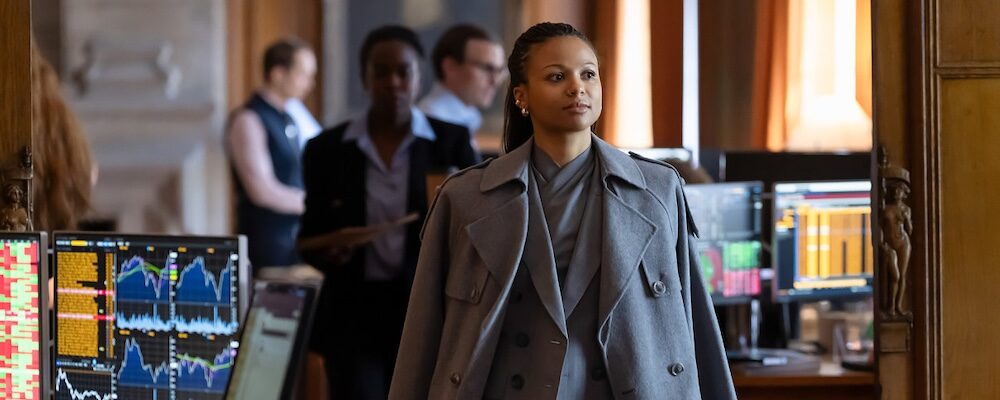
This season opens with Harper behind her office desk, surrounded by computers keeping track of market figures, now aiming her sights at Tender, a payment processor. The company is best known (and notorious) for supporting what are called gray-market industries. These include gambling and pornographic sites, or sites similar to OnlyFans. Tender’s own head, Whitney Halberstram (Max Minghella), is another American in the U.K. trying to build a financial empire. He plays just as hard as Harper, despite starting to feel unease about his co-founder, Jonah (Kal Penn), a hedonist sliding into becoming an irresponsible slob. Still away, for now, from the finance wars is Harper’s rival turned friend Yasmin Kara-Hanani (Marisa Abela). Yasmin’s marriage to aristocrat Henry Muck (Kit Harington) is hitting quite the rough patch due to Henry’s depression after losing the MP vote. They will soon get pulled into the arcane standoff between Harper and Whitney as job offers are made and political dealings become essential.
Viewers barely jumping into “Industry” now would be surprised how much it has changed in terms of its setting. When the first season premiered in 2020, as the world remained in lockdown and no one knew if they would ever go back into an office, the narrative felt like a classic market drama in the tradition of “Wall Street.” It was not that much of a hit, but by its third season had developed a strong following through sheer word of mouth. Harper was the underdog with a fake college transcript, who would eventually be fired for falsifying her credentials. Now she’s flanked by her own staff, Sweetpea Golightly (Miriam Petche), Kwabena Bannerman (Toheeb Jimoh) and Rishi Ramdani (Sagar Radia). They are all written with crackling dialogue. Rishi is particularly memorable, even haunted, since after his wife’s murder, he sells information to get by. Another well-cast new character is Jim Dycker (Charlie Heaton), a financial journalist who warns Harper about Tender’s shady dealings. Jim opens the season with a great club scene where he nearly seduces a source.
The bulk of the most engaging moments early in the season belong to Yasmin and Henry. Passion has been replaced by dreariness. Henry’s insecurities are crushing following his political failure and now he has to deal with the lingering trauma of his toxic family. Heavy drug use is not helping and Yasmin can’t help but berate Henry for not even being able to have sex with her anymore. Shot in Henry’s baroque manor, the ensuing madness is caught with music nods at Stanley Kubrick. The themes of “A Clockwork Orange” and “Eyes Wide Shut” play throughout, ramping up during a darkly hilarious birthday dinner to celebrate Henry’s 40th, where everyone is decked in 18th century costumes. Will salvation come in the form of Whitney? Yasmin reaches out to the Tender CEO to try and see if there is an opening for Henry, but it soon dawns on her that her husband does not have the steely constitution for the financial world.
Harper’s journey is the continuing evolution of a cutthroat operator who nonetheless cannot lose her heart, as hard as she tries. She sleeps with Kwabena in what seems like a casual arrangement, but looks rattled when he jokes about it for being, well, casual. When she realizes she needs real muscle behind her enterprise, Harper calls up former boss Eric Tao (Ken Leung), retired and sipping drinks at a golf course (a certain figure in a red cap golfs in the background, designed to make us think it could be President Trump). Eric will of course get back into the fray, though he warns Harper that as one gets older, letting this life fully consume you seems less worth it. Harper’s scrappiness comes from having nothing, which is why she can fearlessly make demands from someone like Otto Mostyn (Roger Barclay), her benefactor who is now in Parliament. Whitney makes for a formidable foe because he is just as honed. When he can’t take it anymore, he corners Jonah with a board meeting to have him fired. He and Harper meet at a party and hook up, yet it feels like two enemies scoping each other out.
As it rushes towards an excellent cliffhanger ending, season four of “Industry” can also feel like it is trying to balance a bit too many story avenues. Political intrigue is piled on with new characters like Lisa (Chloe Pirrie) and MP Jenny (Amy James-Kelly), who Tender lobbies for government support as a new law threatens to bring scrutiny over its connections to adult sites. Yet, the series sustains its tension through sincere acting and the way it makes arcane financial language as absorbing as all the medical jargon in “The Pitt.” By putting Harper and everyone else into new shoes, the series revamps itself without feeling like a desperate ploy to stay entertaining. We could not expect Harper and Yasmin to remain underdogs forever. With more power comes more responsibility, raising the stakes and making this series a worthy investment.
“Industry” season four premieres Jan. 11 and airs Sundays at 9 p.m. ET on HBO.