
‘H Is for Hawk’: Claire Foy Delivers a Quietly Heroic Performance as an Academic Finding Solace Through Falconry
Alci Rengifo
There are no set rules for grieving. How we confront loss can lead us down unpredictable roads, as demonstrated eloquently in “H Is for Hawk.” This adaptation of Helen Macdonald’s memoir could have easily become a calculated tear-jerker. Instead, director Philippa Lowthorpe and Claire Foy create an evocative drama about the healing potential of connecting with an element of the natural world. In Macdonald’s case, caring for a goshawk tapped into something both intimate and primal, seeming to fill a void left by the death of her father. There is pain in the story but not a cascade of tears. Lowthorpe understands that mourning can be a slow, grinding process.
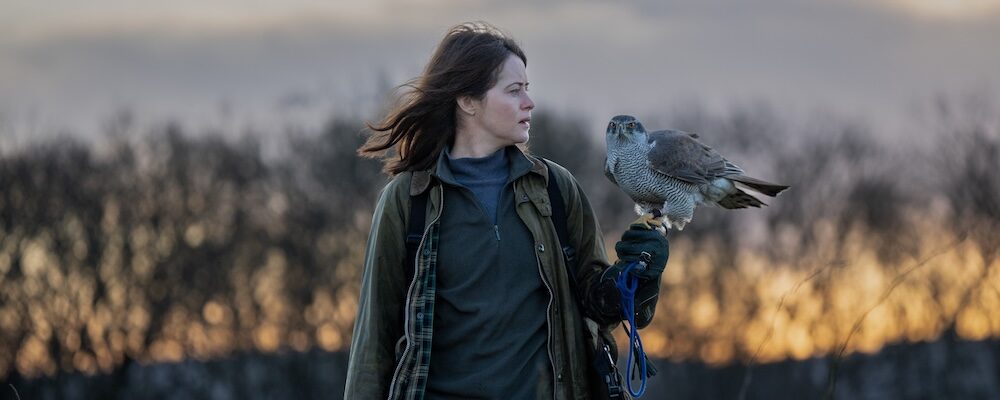
Foy plays Helen Macdonald. In 2007, she is a fellow at Jesus College in Cambridge teaching on philosophy and science. Helen is quite close to her father, renowned photojournalist Alisdair Macdonald (Brendan Gleeson). When Alisdair suddenly dies, it strikes Helen like a thunderbolt. Through her friend Stuart (Sam Spruell), Helen is attracted to the idea of taking in a Eurasian goshawk and learning falconry. She acquires a winged companion, naming her Mabel and is soon learning all the rigors of taking her out to hunt. Helen’s colleagues are intrigued when they see her on campus with the bird, while suspecting she may also be undergoing a potential emotional downturn. This certainly worries her mother (Lindsay Duncan).
“It didn’t feel like a biopic,” Foy told Entertainment Voice about the structure, “Helen is an incredibly interesting person who deserves 15 films to be made about them. I had to, as an actor, pick and choose the particular parts of that person that would be most important to convey, instead of doing an imitation of this person.” In the best way, the role does feel organic. Macdonald’s book was a bestseller that won the Samuel Johnson Prize, so there is already an audience who will no doubt scrutinize how close of an adaptation this is. Taken on its own, there is a welcome combination of clarity to the storytelling where it does not feel the need to become too dense in order to convey Helen’s journey. The screenplay by Emma Donoghue, who also wrote the compelling adaptation of “Room,” combines familiar moments from other films about grieving with the more unique angle of nature as a presence in Helen’s life.
Helen treats spiders with gentleness and has a sensory relationship to trees and vistas, no doubt influenced by her father’s career as a photographer. Flashbacks show how he taught her well in actually seeing the world around them. Mabel becomes a living embodiment of the restlessness in Helen. Cinematographer Charlotte Bruus Christensen shoots with elegance but doesn’t make the film too much of a visual poem. The eloquence is found in how Mabel takes on a presence in Helen’s life. Her sadness is crushing and colleagues notice she has stopped caring much for looking pristine at work. Life begins to make more sense when she sees Mabel hunting, as if it is an affirmation that life continues despite the realities of death. The hawk brings a strength and majesty missing in Helen’s lonely days. A friend like Christina (Denise Gough) will worry about Helen’s well-being, but is keen enough to stand back knowing this is a personal journey her friend has the right to travel alone.
“The idea that there is a right or wrong way to grieve is redundant,” Foy said, “the film is about love and I feel that there is much loss in love and fear of loss in love, and how you as a human being can love and survive that. The relationship between Helen and Mabel is about love.” A production in the more classic Hollywood mold would have attempted to turn this story into some feel-good popcorn experience akin to “Free Willy.” Lowthorpe would rather tap into what could be called the primal energy Mabel starts to represent for Helen. The academic is soon giving lectures on the need for bonding with animals, provoking absurd pushback from an audience member wondering if she is celebrating death by letting Mabel hunt. It would have been intriguing if the material had delved deeper into this area of the complexities concerning animal rights, but the narrative remains focused primarily on Helen’s healing process.
The performance by Claire Foy is quietly heroic, avoiding any safe melodramatic choices. “The Crown” star compels by keeping Helen grounded and vulnerable, essentially portraying sadness as something uncinematic. There is some of the stoicism from her role as Queen Elizabeth II combined with a little disarray from pain. We don’t always need to howl in anguish and throw items around. Genuine loss can create a state of numbness, which is where Helen finds herself until Mabel in a sense brings purpose back. “H is for Hawk” has a warmth and kindness at its core, in the end expressing that pain is natural and freedom can be achieved by trying something new that puts us in contact with another form of life. As Foy said, “the love doesn’t diminish. You have to find a way to have that still existing inside you as you find a way to move on. The love doesn’t go anywhere.”
“H Is for Hawk” releases Jan. 23 in theaters nationwide.