
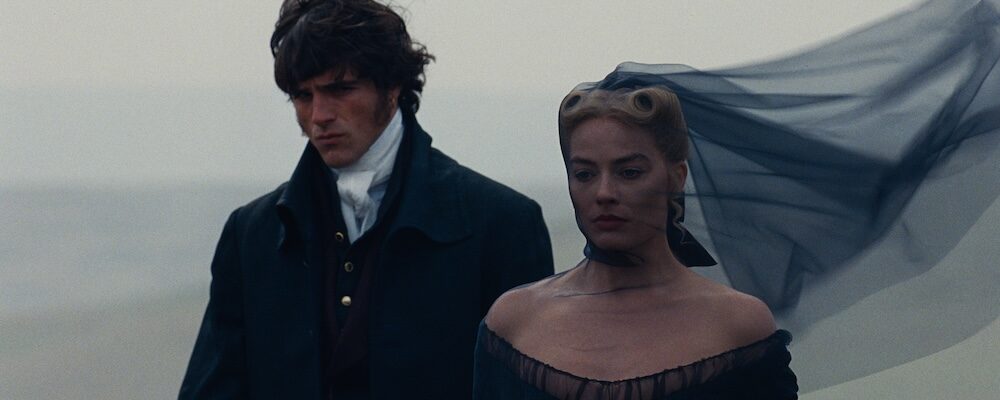
‘Wuthering Heights’: Margot Robbie and Jacob Elordi Lack Steam in Emerald Fennell’s Overwrought Emily Brontë Adaptation
Alci Rengifo
Emerald Fennell’s “Wuthering Heights” sighs and gasps under the impression that you need to pump up the visual volume to make 19th century literature exciting. There is undeniably something quite direct, even primal, in the basics of Emily Brontë’s classic 1847 novel. Since its publication as the only complete novel by the author and poet, there have been endless discussions on its various themes. Many adaptations have wrestled with the work, some resulting in highly acclaimed films. Fennell brushes aside the issues of class, racism, at times even feminism, that have been connected to the book. She’s aiming to make it all about the sexiness, powered by a few Charli XCX songs. What’s missing, oddly enough, is genuine passion.
As with most versions of this story, you just have to open with plenty of mist in the wild Yorkshire moors of Northern England. A little girl named Cathy (Charlotte Mellington) lives with her gambling, drunken father Mr. Earnshaw (Martin Clunes) and servant Nelly (Vy Nguyen). One day, Mr. Earnshaw brings an abandoned orphan to the quickly dilapidating Wuthering Heights ranch. A smitten Cathy decides to name the orphan boy Heathcliff (Owen Cooper). They grow up together, clearly in love even if the emotions are kept subdued. When the wealthy Lintons move into the neighboring Thrushcross Grange estate, Cathy (Margot Robbie) is intrigued. Heathcliff (Jacob Elordi) has meanwhile grown into a gritty outsider. When a chance accident throws Cathy into the arms of the bland but rich Edgar Linton (Shazad Latif), it is expected she will of course marry up. A conversation between Cathy and the icy Nelly (Hong Chau) finds Heathcliff overhearing that his great love will marry the rich guy, and when he misunderstands her reasoning, he flees on a horse. After some time living in luxury, Cathy is stunned to see Heathcliff return from America a polished gentleman with a dark aura.
Aside from added tweaks in Fennell’s screenplay, readers will recognize this as the basic plot of “Wuthering Heights.” From there it is curious how she doesn’t attempt to truly go far. Previous adaptations have eagerly channeled the text’s Gothic character, from a writer clearly influenced by the Romantics. The most famous version remains William Wyler’s Oscar-nominated film from 1939, starring Laurence Olivier and Merle Oberon as star-crossed lovers divided by the cruelties of classism. Another great version was made by the great surrealist Luis Buñuel in Mexico, which also took full advantage of the novel’s evocation of maddened desire. Fennell seems to think that what matters most in this update is to instruct cinematographer Linus Sandgren to flirt with making her adaptation strut like a music video. Visually it’s a pretty movie to just stare at. Giant stone walls that feel almost too artificial enclose Wuthering Heights, while the Linton house looks dipped in every color imaginable. Heathcliff rides off in a fury over a crimson horizon. In a bizarre but fascinating production design choice, Linton has Cathy’s bedroom walls painted to evoke the texture of her skin, including her mole. A montage to Charli XCX’s new song “Chains of Love” showing Cathy enjoying all her new perks feels like an ad.
Fennell keeps the movie performing like a tease for most of its running time, never settling on what it wants to do with the story. She doesn’t care to explore the class issues. The rich are quite nice in her take. Edgar lacks the dismissive contempt towards Heathcliff of earlier versions, treating the interloper so well we sympathize with him. Apparently he is eventually cheated on for being so vanilla. Cathy is never written to feel the weight of societal expectations, thus forcing her to reject her true love. In Robbie’s semi-adolescent performance and Fennell’s direction, Cathy is reduced to being nothing more than a brat. The character did always feature this element, but as another layer of her tragic existence. Here, she has no other layers. There is some hesitancy in Fennell to explore the richer depths of material she chooses to adapt. This was the case with her “Saltburn,” touted as a semi-update of “The Talented Mr. Ripley” while also avoiding the inherent social commentary. It is even odder since Fennell’s directorial debut, the stylish and edgy “Promising Young Woman,” never held back in its stinging critique of misogyny and sexual violence.
Heathcliff is meant to be a dark avenging angel, returning with wealth and a crushing bitterness that he unleashes on those who wronged him. Fennell has controversially cast Elordi when the character is typically portrayed as non-white or with a hint of being mixed, per the insinuations of the book. If Fennell didn’t like this idea, she could have at least used the character for genuine erotic suspense. In the early sections there is a habit for the editing to cut from a double entendre in the dialogue to images such as a slug moving across a windowpane or hands squeezing dough. After a while you wish the movie would just get on with it and have someone’s bodice get torn asunder in throes of lust. Alas, when Heathcliff and Cathy do start meeting in secret there are no genuine sparks. Even sex is filmed with the blandness of a repressed Christian. The one moment where we feel what could have been is an excellent, controlled moment where Heathcliff first kisses Cathy on a hill surrounded by mist. Additionally, there’s the absurd treatment of Cathy’s sister-in-law, Isabella (Alison Oliver). Typically portrayed as an innocent victim in the crossfire of Heathcliff and Cathy, here she’s reimagined as a rather funny, sex-starved freak. Eventually Heathcliff has her in a dog leash at Wuthering Heights for one ridiculous scene.
Such a choice would be fair game if Fennell really went for reimagining the story as a debauched soap opera. She holds back from using the resources at her disposal. Jacob Elordi, currently the talk of the town, has the look for sultry, bombastic drama. His lines are so tame and his performance so subdued, that he wouldn’t be able to hang out in “Fifty Shades of Grey.” He flashes a gold-toothed grin and the potential is clearly there. Why make the walls of the sets poisonous green or burning red if the characters won’t embody them? Emily Brontë’s novel survives because there is something always alive in the prose. This will probably not be the last “Wuthering Heights.” Someone always mines the story for a new miniseries or film. Among its peers, Fennell’s version may be the best-dressed, but it lacks fire in the veins.
“Wuthering Heights” releases Feb. 13 in theaters nationwide.