
‘Merrily We Roll Along’ Captures the Emotional Joy of Maria Friedman’s Tony-Winning Revival of Sondheim’s Once Unappreciated Opus
Alci Rengifo
When legendary American composer and lyricist Stephen Sondheim’s “Merrily We Roll Along” first opened on Broadway in 1981, the results were quite disastrous. Critics thrashed the production and it closed after only two weeks. Sondheim had worked with director Hal Prince to adapt a 1934 play by George S. Kaufman and Moss Hart about a talented composer’s rise to success and all the pitfalls and glories that entails. The Sondheim version most famously flips a sense of chronology around, telling the story backwards. There was enough enthusiasm from a smaller sector of those who discovered the musical to give it cult status, leading to multiple rewrites and revivals. Four decades later, a revival directed by Maria Friedman finally brought the musical back to Broadway, giving it its long-awaited due. After premiering as an Off-Broadway production in late 2022, it made its debut on Broadway in late 2023 to sold-out audiences, was extend for a nine month run, and went on to win four Tony Awards. If you missed it on the stage, now the filmed version of “Merrily We Roll Along” documents the performance, capturing all of its engrossing liveliness at Broadway’s Hudson Theatre.
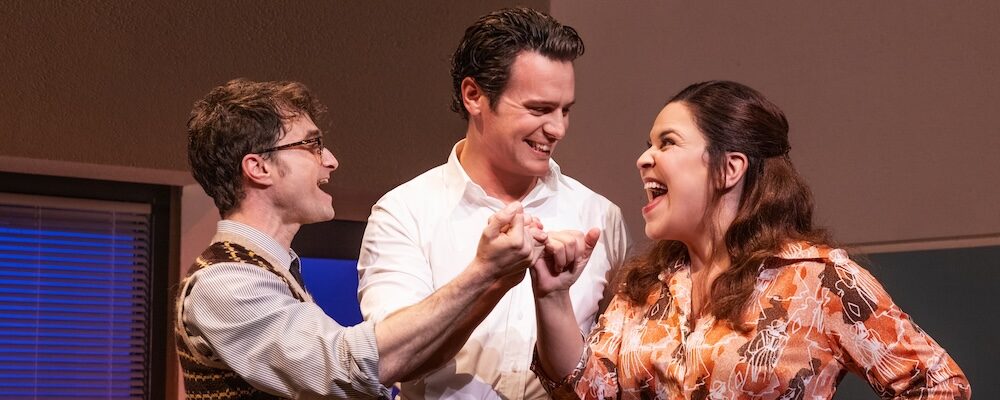
The story begins in 1977 at what is typically the climactic area of a rags-to-riches tale. Franklin “Frank” Shepard (Jonathan Groff), a celebrated Broadway composer who has embraced Hollywood, throws a party for big names. It is also dawning on him that he may have wealth and fame, but little happiness. His second marriage is falling apart and he misses the two friends who were instrumental in his success, Mary Flynn (Lindsay Mendez) and Charley Kringas (Daniel Radcliffe). Mary is now an alcoholic theater critic and Charley has found acclaim as a Pulitzer Prize-winning playwright, though he harbors some deep resentment towards Frank. When the composer tries to reach out to his former comrades, Mary lashes out in a drunken rage. Charley calls him out on live television for being essentially a sell-out. Wishing the past could be recovered, Frank’s memories take us through a journey from how the group fell apart to their early days of youthful dreams in 1957.
As staged by Friedman, “Merrily We Roll Along” becomes a work both vivacious and haunted. The latter may sound curious for a musical that has such cheerful numbers defined by Sondheim’s compositions and complex wordplay. Yet its buried power is in the way the story tackles that classic idea of how fame sounds great but can take a toll. Friedman made a brilliant move in altering the original focus of the show’s book by George Furth. Instead of making the whole friendship between the trio central from the beginning, the focus is primarily on Frank as the center of the group. For Groff, a 20-year stage veteran, in addition to his work as a film and TV actor, this is a particular challenge because he has to portray the evolution of an artist in reverse. With Friedman able to use close ups and filmic edits absent while watching a live performance, small details have a deeper resonance. From the first scene it is instantly heartbreaking to watch Mary’s expressions, as she clearly loves Frank but he never seems to notice (or care) as she watches him switch lovers.
The added intimacy of the camera is crucial for a show that depends so much on the bonds of differing personalities. Daniel Radcliffe, who won his first Tony for this role, has ambition, but of a purer sort. He wants to find success but not by writing crass commercial products. His stresses stem from the work, while the very charismatic Frank dives in without fear, as when the duo perform a song, “Good Thing Going,” for potential backers. Frank has so much confidence while Radcliffe’s Charley is a shaky leaf. Lindsay Mendez generates such empathy with a role that could have easily become pure cornball, as the friend in love with Frank for 20 years. The whole cast’s work is so strong that we can momentarily forget this is the pro shot of a stage performance, even as much of the set remains a kind of flat, universal space where a few set piece changes signal the decades have shifted. Side characters tend to be recurring but evolve along with the main trio. Katie Rose Clarke plays Frank’s ebullient first wife, who loves him so joyfully and with wonderful comedic timing. Reg Rogers has a natural cockiness as the producer who hovers over Frank and Charley’s career, eventually giving them a big break.
Through the various affairs, moments of rejections and triumph, the energy of the cast propels the material forward with Sondheim’s music. For a musical that was slammed when it first premiered, critical hindsight has acknowledged the work here is excellent, from the catchy and reflective opener, “Merrily We Roll Along” to the heartbreaker “Not a Day Goes By,” where Clarke evokes the sheer pain of being in love with an unfaithful husband. The soaring “Our Time,” sung by Frank and Charley as they sit atop their apartment roof dreaming of the future, should be an anthem for any struggling group of artists. Beyond the idea of the creatives trying to make it, “Merrily We Roll Along” has a special power in the way it addresses the passage of time. The story asks us to reflect on where we have come from, as opposed to being obsessed with the future. Looking into the past is one of the few ways we can make some sense of what is happening today. Like the 2021 Disney+ release of “Hamilton,” this is a great way to watch a production. When Frank undergoes his first divorce, the camera moves in on him contorting in pain on the ground, unable to bear losing his family. Cinema adds that emotional heft with the right shot. Richard Linklater has actually begun filming a movie adaptation of the musical, with a planned shoot to last 20 years (in the same way he shot the acclaimed “Boyhood”). Until that is released, we have this gem.
“Merrily We Roll Along” releases Dec. 5 in select theaters.