
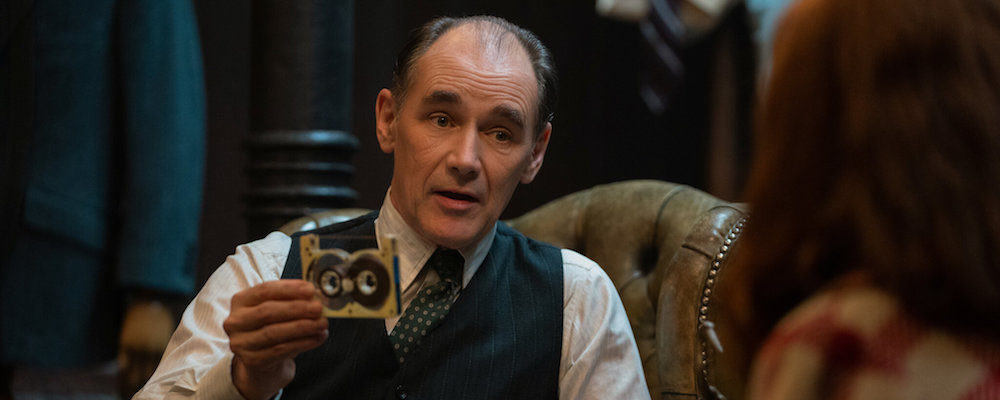
‘The Outfit’: Mark Rylance Gets Caught in a 1950s Chicago Gang War in Well-Tailored Crime Drama
Sandra Miska
An outwardly mild-mannered and refined British man living in 1956 Chicago finds himself in the middle of a bloody gangland war in “The Outfit,” the first feature film directed by Oscar-winning screenwriter Graham Moore. Mark Rylance, stars as Leonard, a tailor, or cutter, as he calls himself, who has dedicated his life to his craft, having trained and previously owned a shop on London’s famed Savile Row. But in Chicago, the city he relocated to after WWII, his best clients aren’t aristocrats or respected socialites, but high-powered mobsters. Leonard and these men, including mob boss Roy Boyle (Simon Russell Beale), and his less effective son, Richie (Dylan O’Brien), have what seems to be cordial business, even friendly relationships, until a fateful night depicted here.
“The Outfit” takes place entirely within the confines of Leonard’s shop, which Moore and his team built on a soundstage. “It all had to feel very real, and the verisimilitude to that was extremely important to me,” the writer-director explained to Entertainment Voice. “It was important to me to build the entire film on a stage so we could control the entire set from the floor to the ceiling.” It’s impressive that so much can go down in such a small location, especially one run by a quiet lone wolf like Leonard. His only employee is Mable (Zoey Deutch), a young woman he exhibits paternal feelings towards, and she likewise feels protective of him. Leonard’s shop resembles what one imagines his Savile Row shop would have looked like, save for the box in the back in which Boyle and his associates drop and pick-up communications.
The plot gets into gear one night when Richie and another member of his father’s gang, Francis (Johnny Flynn), show up after hours, and it’s not to have a last-minute jacket fitting. Richie has a gunshot wound and Francis forces Leonard at gunpoint to patch him up using his needle and thread. Despite some understandable nerves, Leonard turns out to be surprisingly efficient at sewing up a wound. Either doing sutures on human skin isn’t all that different from sewing garments, or this is the first of many clues that Leonard has a complicated past. But he isn’t in the clear, as the men inform him that an FBI bug has been planted in his shop, and they’re determined to find out who the rat is.
Leonard’s predicament is not all that far-fetched. After his co-writer Jonathan McClain came up with the idea to write about a Savile Row tailor, the pair learned some interesting things while conducting research. “We had the idea for the character first, and then for a while we were trying to figure out what the story we wanted to tell around him was, and we found this single sentence buried in a book about tailoring history about how — this is true — the first bug the FBI ever planted was in Chicago in 1956 inside a tailor shop. Instantly, we lit up. We said, ‘Oh my gosh, that’s the story.’”
But Moore’s main inspiration was his own grandfather, a small-town doctor who attended to notorious mobster Jerry Catena. Revealed the director, “To the family, this was always quite shocking, and to me, it was sort of fascinating. How could my gentle, sweet, kind grandfather treat this man who we know was this vicious killer? I always imagined what went on between them behind closed doors.”
And what goes on behind the closed doors of Leonard’s shop quickly spirals when after witnesses a murder and is forced to help with the cleanup, both literally and figuratively. Tension builds as more players come into the mix, including Roy Boyle, as well as Zoey, who might not be as innocent as the viewer was initially led to believe. Nigerian-British actress Nikki Amuka-Bird even shows up late in the game as Violet LaFontaine, the leader of the Boyles’ rival gang. On the outside, this glamorous African-American woman is not who one imagines when they think of gangsters of this era, but she proves to be every bit as fearsome and even more cunning than the men encroaching on her turf.
Moore explained that he based Violet on a real woman, Stephanie St. Clair. “She was actually in New York, but we moved her to Chicago for the purposes of our fictional film. She was born in Haiti, came to the United States and became, honestly, one of the most powerful gangsters in America in the middle of the twentieth century.”
There’s a lot of moving parts in “The Outfit,” and the name of the film turns out to have a double meaning, as doesn’t just refer to clothes, but a real-life national criminal organization the fictional Roy Boyle aspires to be a part of, and only that pesky rat stands in his way. Explained Moore, “It was sort of a United Nation of crime where different gangs in different cities in America could all unite under [them] for shared protection. They would kind of have everyone’s backs together against the FBI or anyone who tried to mess with them.”
Although the eventual ending of “The Outfit” and reveal of the rat is a little too convoluted, it’s fascinating to watch the journey, and this is in no small part due to Rylance’s phenomenal performance. The most memorable parts of the film do not involve any guns or violence, but Leonard’s one-on-one, high-stakes conversations. Just as was the case when he played Henry VIII’s chief minister Thomas Cromwell in the series “Wolf Hall,” he gets by staying calm, sometimes even eerily so, and using his wits.
Moore explained why Rylance was a gift to him as a first-time director. “It makes things a lot easier to get to show up in the morning and say, ‘I have an idea. Let’s point the camera at Mark Rylance. Something great will happen.’ And sure enough, it does, and I get to take all the credit for it. No, he’s amazing. I think Mark reminds me so much of the protagonist of the film. His character, Leonard, is this expert tailor. I think Mark is such an expert craftsman himself. Mark is someone who has spent decades and decades studying and perfecting, with a single-minded pursuit, the mysterious and spooky craft of acting.”
Finally, there are the clothes themselves, and while they are not the main focus of “The Outfit,” they are integral to the story. “It’s a unique film in so many ways, but one of those ways is it is a film about a character who has a very particular set of aesthetics,” said Moore. “It’s a film about a guy who makes clothes in a very particular way, so the whole look of the film, photographically, auditorily, musically, had to reflect our main character’s aesthetics. The whole film had to look and feel like one of his suits, like something he would have made.”
Fashion designer Zac Posen came onboard not only to design the costumes, but to also act as an advisor, because, as Moore explained, he is a fashion historian. “Zac Posen is like a walking encyclopedia of fashion history, fabric history and clothes construction history. From the earliest script stages, Zac was reading scripts and giving notes and saying, ‘On page 41, you have him using this kind of iron. No, in 1956 he would have ironed a jacket with this other kind of iron.’ That attention to detail from Zac was tremendous.”
“The Outfit” releases March 18 in theaters nationwide.