
Steven Spielberg’s ‘West Side Story’ Brings New Vigor to a Beloved Classic
Alci Rengifo
At first glance, the idea of reviving a classic like “West Side Story” might seem like pop cultural blasphemy. The 1961 adaptation of the Leonard Bernstein and Steven Sondheim production is such an established institution, that only Steven Spielberg could have the drive to make it his own. And he does. This is a vibrant, dynamic version that makes the musical fresh and new while harkening back to cinema’s technicolor era. The 1957 Broadway production, conceived by choreographer Jerome Robbins, was famously inspired by Shakespeare’s “Romeo & Juliet,” so by design it can be reinterpreted endlessly. Spielberg digs to the heart of the story, bringing out what could only be hinted at in 1961. His “West Side Story” is still set in the past, but speaks in very urgent ways to America as it is today.
For those who might not know the story, the place is New York City in the late ‘50s. Two gangs roam the streets, the Sharks, who are mainly Puerto Rican, and the Jets, who are mostly white. They fight for territory, resentment with tinges of racism hovers in the air, yet they are all social outcasts. Leading the Jets is scrappy Riff (Mike Faist) while the top alpha for the Sharks is boxer Bernardo (David Alvarez). Riff is trying to convince former Jet Tony (Ansel Elgort) to get back into the gang for a big rumble with the Sharks, but Tony likes the idea of having an honest job at a local shop owned by Valentina (the legendary Rita Moreno). Fate has other plans when during an evening dance, Tony locks eyes with Maria (Rachel Zegler), Bernardo’s sister, who lives with him and his girlfriend Anita (Ariana DeBose). The star-crossed lovers now face the challenge of having to be together while living within warring factions.
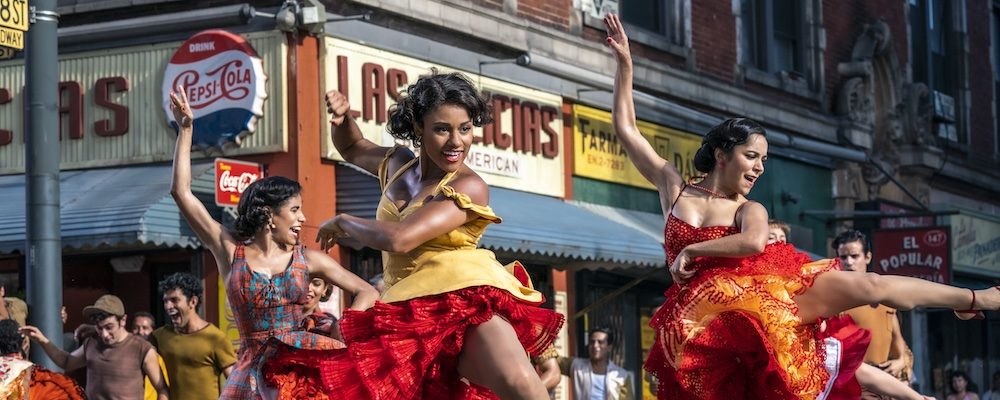
Part of the trick in Spielberg’s approach is that he isn’t remaking the 1961 movie directed by Robert Wise, which won 10 Oscars including Best Picture. His direction, and the structure of the Bernstein score, conducted here by Gustavo Dudamel with verve, is more influenced by the original Broadway production. As pure cinema, “West Side Story” is an exhilarating experience. Spielberg reimagines classic numbers with his eye for rich visual energy. His regular cinematographer, Janusz Kaminski, composes widescreen frames both vivid and evoking classic Hollywood. Several dance sequences stand out for their sheer dynamism, like the color-packed mambo at the gym dance. “America” becomes a riveting stroll through New York’s Latino neighborhoods, led by Anita, culminating in an overwhelming climax of dance, editing and magnificent singing. The song truly comes alive as a statement on the internal debates going on in every immigrant community, between those firmly attached to the American dream and those who realize it isn’t so easy, or welcoming. Spielberg also finds the poetry in the musical’s well-known romantic songs. Tony’s reflection shimmers in a street puddle during “Maria,” and their first, delicate dance to a “Cha Cha” is now filmed behind bleachers with the kind of lushness a YA movie can never reach. “I Feel Pretty” is now staged like a loving tribute to essential workers, the immigrants sweeping and cleaning shops where the more comfortable spend. The photography is rich but this isn’t some technicolor New York City, but one with rainy and shadowy streets as well, with the Jets dancing through the rubble of buildings torn down to make way for glitzy new apartments.
Another essential component is that acclaimed playwright Tony Kushner has written the screenplay. Kushner previously wrote “Munich” and “Lincoln” for Spielberg, two of the director’s most complex, intellectually stimulating films. The author of “Angels in America,” Kushner belongs to a particular breed of politically conscious, even radical, playwrights. He elevates the messages in the lyrics by Sondheim, who passed away only recently, by giving the drama more grit and social bite. The police, represented by Lt. Schrank (Corey Stoll), are not only hard on the gangs but more openly racist. Schrank warns the Jets the old white order is going to be replaced by more brown immigrants, who speak Spanish defiantly, no less. After the opening prologue sweeping through streets as gang members dance to Bernstein’s notes, Schrank faces the Sharks as they sing “La Borinqueña” with raised fists, an independence rallying cry. Kushner’s dialogue emphasizes the dilemma that while the white Americans may dislike the Sharks for speaking Spanish and being Puerto Rican, they tend to forget Puerto Rico is actually a U.S. territory. There is also dialogue in Spanish without subtitles, but with acting so expressive anyone in the audience will know what is being conveyed when heartbreak or death are announced.
Because Spielberg remains the world’s most famous director, it is easy to take for granted that he has access to endless resources. Less discussed is how he has used this freedom to make meaningful films in-between his popcorn extravaganzas. He can also take chances like not packing the entire cast with marquee names. Rachel Zegler makes her big screen debut with a warm, ebullient presence that has a tougher edge than Natalie Wood’s famous performance. She is nearly overshadowed by Ariana DeBose, a Tony nominee for “Hamilton,” who as Anita, like Rita Moreno before her, is incandescent. She wants the American dream because she’s tired of being poor and also flaunts her Puerto Rican identity in front of the Jets like a banner of pride. Her casting is key because it breaks the mold of Latinx stereotypes on film, capturing more accurately an Afro-Latinx identity within Caribbean culture. How can the men possibly keep up? Ansel Elgort of “Baby Driver” fame has been getting the less enthusiastic notices, yet he fits Tony efficiently, with a look and voice that feel taken straight out of the era. “West Side Story” is a romance and he fits the part of Maria’s prince charming in a ‘50s fantasy. His perfect opposite is David Alvarez, another show stealer as Bernardo, full of macho pride. He’s also given the complexity of an immigrant who doesn’t quite buy into the whole American promise too much. His fists can get him places, but he also realizes there’s a social food chain involved where non-whites are pushed to the bottom. There is also Rita Moreno, not merely doing some nostalgic cameo, but playing an essential character with wise gusto and singing “Somewhere” with powerful emotion.
“West Side Story” boasts a great cast and choreography by Justin Peck that never dares shadow Jerome Robbins’ original work. Instead Peck invents fluid bursts of expressiveness, just look at how he designs “Cool” as a standoff over a wooden surface with threatening, gaping holes. Above all this, Spielberg’s reimagining is justified in how the material still speaks to us today. When the 1961 film premiered some critics like Pauline Kael still critiqued it for being too cheesy in how it delivered its message. Now Spielberg and Kushner have made the story richer and more urgent. More clearly, it is about the artificial borders that divide us, and how inequality leads to the downtrodden fighting amongst each other instead of uniting. When Tony and Maria lock eyes in that gym dance, for a moment their ethnicities or invented labels don’t matter. The buried message in Bernstein’s music and Sondheim’s lyrics is that such an attraction can be dangerous when it defies cultural conditioning. No one can quite articulate why they hate Puerto Ricans, or why Tony shouldn’t be with Maria. That’s the real tragedy that leads to the intense crescendo of the story. Spielberg does what all great directors should do with a revival and helps us see this musical in new ways. “West Side Story” is like a great movie that should have been released 60 years ago but is instead one of this year’s best films.
“West Side Story” releases Dec. 10 in theaters nationwide.