
‘Michael’ Breathlessly Recounts Michael Jackson’s Rise Without Digging Deeper
Alci Rengifo
Antoine Fuqua’s “Michael” challenges itself to see how much of Michael Jackson’s story can be condensed into a two hour movie. Anyone who knows about his music realizes this is no small feat. Jackson is a pop culture icon of such stature and controversy that handling him as drama is even more daunting than others of his contemporaries. He was a child prodigy who grew into one of the greatest of all entertainers, mastering various levels of his craft to the fullest. Jackson also became fascinating and divisive over his sheer personality and glaring psychological questions. He pushed to the limit the idea of being eccentric. Fuqua’s much-anticipated biopic arrives attempting to be a feel-good entertainment while just barely trying to prod into what made Jackson tick. Jaafar Jackson, nephew of Michael, goes all in to play his uncle. Yet, it’s a physically exhaustive performance relegated to simply re-creating the moments most of the initial audience will already know by heart.
The story begins where it typically does with Jackson, during the 1960s when Joe Jackson (Colman Domingo) shapes his five sons into a group that will become the Jackson 5, forcing them to practice with an iron will. Any signs of exhaustion or pushback will result in Joe unleashing his belt, even on 5-year-old Michael (an impressive Juliano Krue Valdi). After playing numerous talent shows and other circuits, a performance at Chicago’s Regal Theater in 1968 brings the group to the attention of Motown. Jackson 5 enters the recording studio with the label’s legendary head, Berry Gordy (Larenz Tate), who becomes a kind of second father figure to little Michael. As a young boy, the rising star feels the alienation of not having a normal childhood, escaping into books like “Peter Pan.” The timeline then jumps to the late 1970s, when a now grown Michael (Jaafar Jackson) feels the need to establish his own career and artistic identity. He teams up with maverick musician and producer Quincy Jones (Kendrick Sampson) to record 1979’s “Off the Wall.” Yet, as Michael continues to achieve immense success, his father hovers over him as an intrusive, controlling presence.
So the story carries on from there through the basic highlights of the very public career of Michael Jackson. While the directing is by Fuqua, best known for stylized work like “Training Day,” “The Equalizer” and “The Replacement Killers,” and the screenplay by “Gladiator” scribe John Logan, this film is a surprisingly brisk jog at 127 minutes. It is easy to sense the filmmaker struggling with aspects of the story that deserve deeper psychological probing, while clearly adhering to whatever is allowed by Optimum Productions, a company formed by Jackson. The surviving siblings, Jackie, Jermaine, Marlon, and La Toya, serve as executive producers. With very rare exceptions, such deep involvement by the family tends to result in pure hagiographies. None of the darker or edgier side of the story is on display. Even Studio 54 is depicted as a rather tame hang out with lots of cool lights. Transitions are in such a rush that we barely even get any insights into the music. From “Off the Wall” there’s just a brisk splicing of Michael in the studio recording “Don’t Stop ‘Til You Get Enough” and taping the music video. Where he was grabbing ideas or influences is left up in the air. Then it is back to record executives sitting in front of a stern Joe, who insists Michael has to tour with the Jackson 5 and not solo.
Maybe Fuqua tried in vain to hint at the deeper issues at play. We get plenty of moments where Michael feels lonely, clearly becoming a psychologically stunted man. As a kid he can’t hang out with children his own age, telling his mother, Katherine Jackson (Nia Long), that they see him as an object. Her reply is that he is special and like no one else. Entering his 20s, he buys Bubbles the Chimp to have a buddy, as well as giraffes, a snake and lots of kid’s toys. His older brothers scoff when he tries to get them to play Twister. When he opens his favorite Peter Pan book, there is an almost subtle way in which the chosen illustration of the literary hero who never grows up looks eerily like Jackson in his last years, after his multiple surgeries and treatments. None of this is explicitly treated as an individual cries for help under a crushing loneliness or other emotional turmoil, but as breezy, almost cute details of a quirky guy. Even his nose job points to a man uncomfortable with his own self image, but then it becomes about Michael returning home bandaged, to face an upset Joe. At least such moments come close to some richer dramatic territory, hinting at the scars Jackson never overcame and which drove his physical reinvention. What about the other brothers? Jermaine (Jamal R. Henderson), Marlon (Tre Horton), Tito (Rhyan Hill) and Jackie (Joseph David-Jones) are less than footnotes, reduced to being glorified extras that appear and then disappear. Janet Jackson doesn’t exist at all and La Toya (Jessica Sula) appears once or twice for a hug.
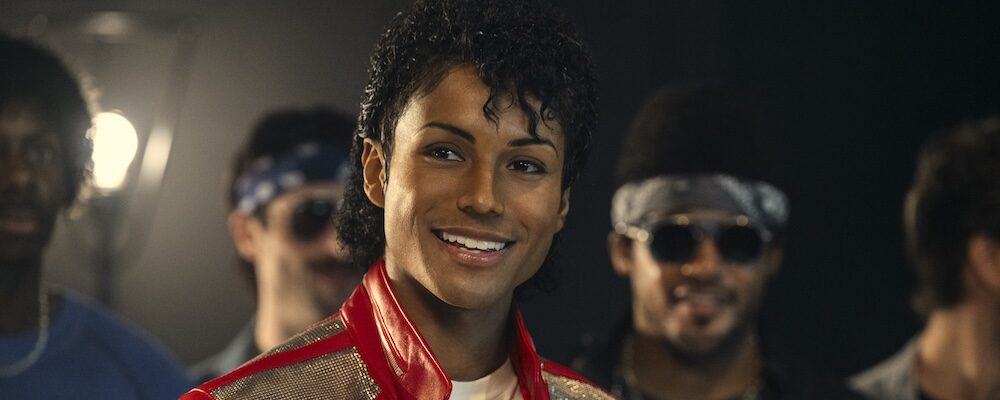
Take away the few family moments and “Michael” is left as a game of guessing how close Fuqua and Jaafar Jackson can recreate famous memories. We get lengthy scenes re-creating the filming of the “Beat It” and “Thriller” videos, consisting of Michael walking in wearing his famous red leather jacket from the era, smiling at the assembled dancers and street performers before dancing into immortality. The legendary performance of “Billie Jean” at the 1983 “Motown 25: Yesterday, Today, Forever” TV special, where Jackson first performed the moonwalk, is clumsily shot, edited and feels just thrown into the movie’s flashy blender. How the makeup, costumes and sets are revived is impressive, to the point that you might wonder why this is all necessary when you can go on YouTube and watch the originals featuring the real icon. The film never even bothers to do the cliché move of reminding us that Ronald Reagan was president and the Cold War was still on. Quincy Jones is meanwhile relegated to just snacking in the studio or telling Michael how great he is. The same is true of Michael’s manager, John Branca (Miles Teller) and CBS Records CEO Walter Yetnikoff (Mike Myers, though the scene could have been played by anybody).
Jaafar Jackson surely deserves to have his effort acknowledged. The dance sequences and concert scenes are not easy feats and never are we in doubt he is dancing or even singing in the wide shots or close-ups. He also captures with pristine accuracy Michael Jackson’s mannerisms and ambiance of a man forever trapped in childhood. If only the script pushed him further. Colman Domingo virtually steals the show. Yes, his Joe Jackson is written as a completely shallow villain, angry and abusive for no discernable reason other than blind ambition. We only get the sense of a human behind the frown when he is clearly hurt when little Michael hugs Berry Gordy in the studio. Then it’s back to the blinding spotlights for closing concert sequences, including a rousing performance of “Bad,” marking Jackson’s true breakaway from the family with the release of 1987’s “Bad.” The music is indeed the best part, since all the songs selected for the soundtrack are timeless, from those early Jackson 5 gems like “I Want You Back” to Jackson’s masterpieces such as “Man in the Mirror.”
Jackson’s detractors will be most upset that the film never references the singer’s later legal troubles. Yet, there is plenty already available such as the highly controversial “Leaving Neverland.” When it comes to the astounding artistry of Jackson’s work, Spike Lee’s documentaries “Michael Jackson’s Journey from Motown to Off the Wall” and “Bad 25” are exciting, judicious explorations into the singer’s creative process and cultural significance as a key Black American artist. What “Michael” fails to do is to then find the kind of depths only drama can truly manifest. It should have freed itself from the need to have actors dress up and make us say, “Wow that really does look exactly like the ‘Thriller’ video!” You can celebrate the art and aim for broader truths as even a TV miniseries like “The Temptations” accomplished in the ‘90s. Jackson is such a complex and larger than life figure he deserves an approach akin to “Amadeus.” So much great, honest art, even exhilarating pop music, comes from both joy and suffering. “Michael” plays it too safe.
“Michael” releases April 24 in theaters nationwide.