
‘Teenage Sex and Death at Camp Miasma’: Gillian Anderson and Hannah Einbinder Are Brilliant in Jane Schoenbrun’s Dreamy Bloodbath
Alci Rengifo
Jane Schoenbrun is quickly becoming one of those filmmakers with a distinctive voice. They have established such a firm style that if it remains consistent, you’ll be able to spot their work in just a few frames. A key feature of that style is nostalgia. “Teenage Sex and Death at Camp Miasma” continues Schoenbrun’s obsession with the recent past, and the way we remember it through the haze of pop culture. For millennials and viewers even older, this means recalling moments and films that shaped us as if through a VHS filter. This is technically a horror film, but Schoenbrun cares little for traditional narrative beats. They want to create satire and explore characters with the language of dream logic.
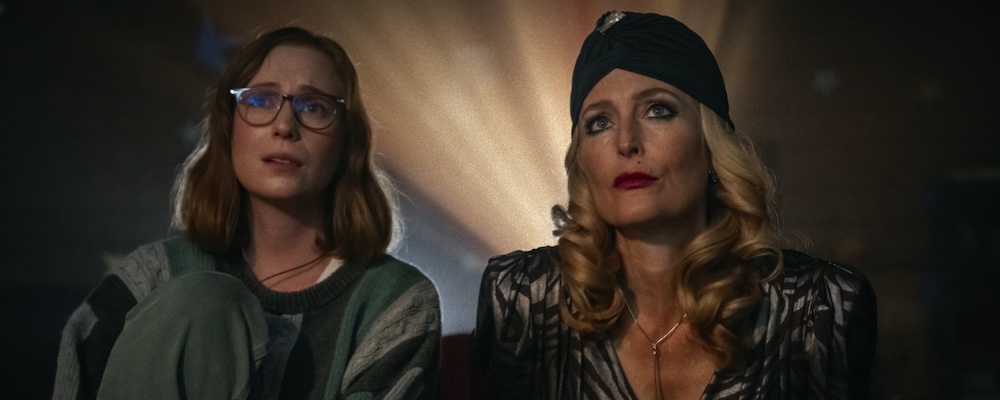
Set to a cover of R.E.M.’s “Nightswimming,” the opening of the film is a feverish rush through a slasher franchise called “Camp Miasma,” which can best be described as similar to “Friday the 13th” and its kin. Teens are chased around by a killer called “Little Death,” who has a square-like mask or helmet covering his face. Endless sequels followed the first film’s success and lovingly designed VHS tapes adorn the screen, since up until the aughts, it was the only way to catch up with something you missed in theaters. The story then cuts to the present, where a young queer director, Kris (Hannah Einbinder), has been hired to direct a “Camp Miasma” reboot. As a child, Kris was deeply impacted by the franchise and for inspiration, wants to meet Billy Presley (Gillian Anderson), the actor who starred in the films as the good girl being chased by the slasher. Billy now lives secluded in Camp Trivoli, where the movies were shot. The seasoned actor welcomes the new director, who she knows became a festival sensation with a thriller described as “’Psycho’ from the perspective of the shower curtain.” As Kris pitches her idea for a remake and hopes Billy will consider appearing in it, the lines between fiction and desire start to blur.
It would be so easy to simply compare Schoenbrun with David Lynch, in particular after their previous film, “I Saw the TV Glow,” a trippy commentary on gender and identity through obsessions with ‘90s television memories. Yet, they do have the ability, like Lynch, to tap into cinema’s potential to become a visible stream of consciousness experience. The central premise is a mere starting point, at times threatening to feel too dense for viewers unaccustomed to this sort of filmmaking. Moods and images are the heart of this film, including quirky production design choices like giving Kris a ludicrous obsession with candy so she wanders down store aisles with a cart full of it, and later will be lying in the ground surrounded by wrappers. Billy has nothing prepared when the director arrives, and has ordered KFC before they get into an existential discussion. It all feels like a millennial or Zoomer version of “Sunset Boulevard,” allowing Gillian Anderson to again shine and prove why “The X-Files” star has rarely chosen a bad role in over thirty years.
How to describe the rest of this film without spoiling or getting arcane about its secrets? Billy and Kris sit down to watch “Camp Miasma” and we are then pulled into a film within a film, as if walking through the very textures of the franchise. Cinematographer Eric Yue composes many rich shots in this film and in this section goes all out, creating a grainy dreamscape where classic horror images take on a dreamlike resonance, even when it comes to a recurring shot of Little Death’s hand holding a weapon from beneath a lake. A psychological sexual dance ensues between the director and actor, connecting to Billy’s descriptions of being scared and aroused by a sex scene in the film that obsesses Kris, whose queer awakening is linked to watching these movies as a young girl. As in “I Saw the TV Glow,” Schoenbrun is fascinated by how a generation growing up on home media, and now social media, can connect milestones to the images they consume. Film and TV can become the equivalent of the cliché of remembering what song was playing when you lost your virginity. The “Camp Miasma” killer, Little Death, has a name linked to a French term for sexual climax, “La petite mort.” Violence and sex have a thrill that can be linked through art, in particular pop entertainment.
“Teenage Sex and Death at Camp Miasma” deserves multiple viewings, first for the sheer experience of its atmosphere where the woods surrounding Billy’s home feel surreal, like a hallucination the women inhabit. Second, one should re-watch the film for its symbols and satirical meaning. Not all of it will cohere instantly during a first pass. Strange passages begin to speak of Little Death inhabiting the bottom of the Camp Trivoli lake, and from here, Kris concludes, the plots of the “Camp Miasma” films are formed and threaten to link to her own life. What? How? Like a dream, it’s like the subconscious melding everything we consume during the day into strange psychological landscapes. The music by Alex G sets the tone with rich waves of sound punctuated by a few needle drops.
Hannah Einbinder meanwhile delivers some of her best work since HBO’s “Hacks,” playing Kris like what is likely a channeling of the director. She is a smart creative who wants to make her “Camp Miasma” as something entertaining but that will address the genre’s infamous sexism. When meeting with executives on a hilariously corporate zoom call, she has a wild breakdown that could connect to Little Death emerging into the real world, or it’s just a reaction to how shallow suits want to bend her art. Sarah Sherman is particularly good as Kris’ cliché of an agent. Gillian Anderson then compliments the younger actor’s performance with the air of experienced sexuality, opening up about what the film did to her and why she is now connecting to Kris. Yet, Little Death will emerge and Schoenbrun basks throughout the film in satirizing the violence of slasher films, depicting decapitations and disemboweled victims with comic geysers of fake blood. They close, fittingly with plenty of gore and candy. “Teenage Sex and Death at Camp Miasma” is a wildly original work celebrating both the popcorn films that hit hard when we’re young and the bizarre, poetic dreams they might inspire and which we may not understand, but feel.
“Teenage Sex and Death at Camp Miasma” releases Aug. 7 in theaters nationwide.