
‘Sputnik’ Brings an Original Style to Familiar and Gruesome Sci-Fi Thrills
Alci Rengifo
There is something terrifyingly compelling about the thought of a foreign invader inside your body. Time and again, some of the best science fiction touches on the theme of our anatomy becoming the host to something unpleasant. “Sputnik” conjures this fear with a fresh, eerie ambiance. Russian director Egor Abramenko takes familiar elements and transports them to a fable set in the USSR in 1983. The result is both recognizable and new. Abramenko is not a director of cheap scares. He uses the slow burner effect to make us fear the shadows that decorate his movie.
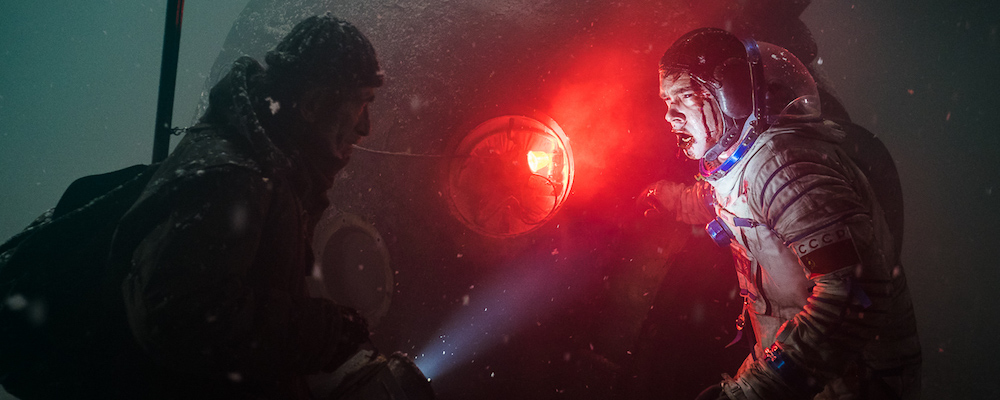
“The story came from my admiration of science fiction as a genre,” Abramenko told Entertainment Voice. “Since my childhood I was a huge fan of this genre. I was deeply influenced by directors like Ridley Scott, Steven Spielberg, John Carpenter, to name a few. When the time came to make my first feature, I knew it would be science fiction.” Abramenko’s story opens above Earth, in a Soviet spaceship where two cosmonauts, Konstantin Veshnyakov (Pyotr Fyodorov) and Averchenko (Aleksey Demidov), see something crawl outside their vessel. Cut to them crashing back on Earth, Averchenko is mysteriously dead, and in mutilated fashion. Veshnyakov is alive and taken to a base in Soviet Kazakhstan. A psychologist already under scrutiny for her methods, Tatyana Klimova (Oksana Akinshina), is called in by the military to examine Veshnyakov. His memory is blank and he cannot remember the events that led to the crash. Klimova soon realizes another, horrifying situation. Late in the night, an alien creature crawls out of Veshnyakov, then crawls back in. It is using the cosmonaut as a vessel. Klimova’s mission soon turns from mere psychoanalysis to attempting to separate the possible symbiote from its host.
It is easy in film circles to compare anything new from a Russian director to the greats, like Tarkovsky or Klimov. But Abramenko does indeed bring that unique sensibility of Russian cinema to a plot that is also universally inspired by classic sci-fi. You can instantly see traces of “Alien” or “The X-Files,” but reimagined in a Soviet setting where high military brass want Klimova to separate the alien from Veshnyakov for their own reasons, even as she tries to discover how the creature works. Atmospheric tension combines with moments of horror, not least when the creature, codenamed Sputnik, feeds on human heads. “I was most interested in the theme of alien invasions, but at one point this idea of first contact that unfolds during the ‘80s Soviet Union, which involves all that conspiracy KGB stuff, came to me and I felt it was a great idea,” said Abramenko. “We did what’s called a ‘proof of concept’ short, titled ‘The Passenger,’ which was a sort of prequel to ‘Sputnik.’ It was a short introduction to the world, it set up the hero. At the end of that short movie we showed the main character, which is the creature itself. The short worked out, we premiered it at Fantastic Fest in Austin. After that, it wasn’t so hard to convince some studios to invest their time, so we could do the feature.”
A major part of the enveloping nature of “Sputnik” is its casting. The actors never play up the fact that they are in a science fiction creature feature. Oksana Akinshina, a veteran of numerous Russian films, Pyotr Fyodorov and Fedor Bondarchuk as the military commander always hovering over Klimova, bring a special seriousness to their roles. They do come across as individuals undergoing a frightening, unexplained phenomenon. “As you can imagine, we have a huge amount of movies that depict the Soviet period. We even have this kind of cliché actor who can play a Soviet citizen. Our goal from the start was to cast against type. Most important for me was to find actors who feel a personal connection to their character. The character development was a crucial element. From the start, we didn’t want to make archetypes. We wanted to come up with live human beings, people with backgrounds and personal stories. We tried to design each character that way. We wanted three-dimensional characters.”
Essential to “Sputnik” is its alien threat. The extraterrestrial parasite that takes over Veshnyakov has the slithery, otherworldly design we would expect. Abramenko is careful to not let its scenes always turn into scrambling action scenes. He lets the camera linger on the digital creation as it slops on the floor, snarls and prepares to strike. Instead of bursting out of its victim it slowly exits because it plans to go back inside. “There was the challenge of coming up with something original in terms of design, something that could convince the audience and eventually terrify them. It was hard to do that because we knew it would have resemblances to the xenomorph in ‘Alien’ and other iconic creatures. It is about the physical feeling of having something else living inside of you, this creature. I recall a meeting with the producers and concept artists, and someone just said, ‘imagine a snake living inside your body and getting out every night through your mouth.’ That image that stuck behind our eyes and became the blueprint for further developments.”
In the tradition of great science fiction, “Sputnik” invents its creatures and conspiracies as a channel for greater, primitive fears. Klimova tries to reach into the psychological depths of the possessed cosmonaut, while Bondarchuk’s military figure represents governments suppressing dark truths for their own ends. It’s almost an allegory not only for the Soviet system, but any government. As the story progresses, Klimova and Veshnyakov are not so much fighting the alien as they are running from the system.
Claustrophobic, obsessed with alien threats to our bodies, “Sputnik” is a great midnight watch, with an eerie feeling appropriate for a year beset by the unknown. “It was a coincidence that we came out during the pandemic, during all that crazy stuff that’s happening right now in the world. From the start we’ve been trying to tell a very universal story in terms of human relationships, human qualities… science fiction is a great genre to speculate on very different and universal themes. The personal reason why I picked this genre is because it allows itself to be used like a tool, to tell unique stories, to expand the boundaries of your walls.”
“Sputnik” releases Aug. 14 on VOD.