
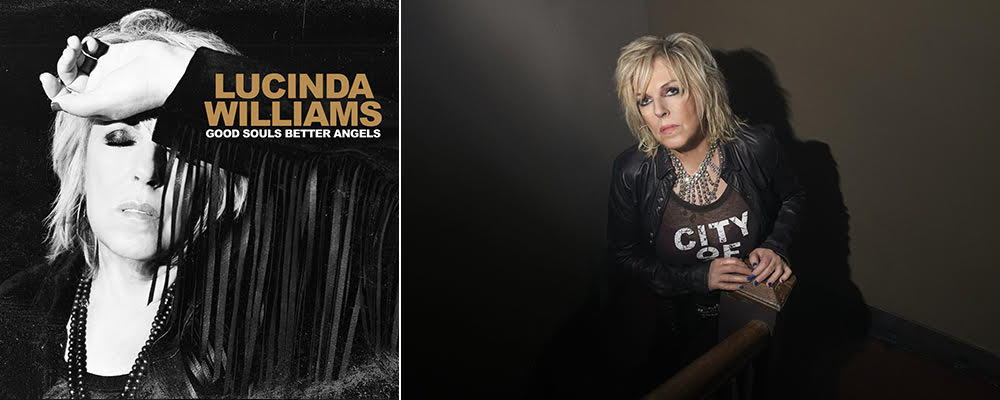
‘Good Souls Better Angels’ Captures Lucinda Williams In Dark Theatrical Blues Grandeur
Adi Mehta
If there ever were a time that justified the blues worldwide, it would likely be today. As we find ourselves at the mercy of a bleak 24-hour news cycle, clinging desperately to any hope we can sustain, our worries and our hopes are articulately and passionately reflected by the great Lucinda Williams. Having kept at it for over four decades, Williams has remained prolific, with her last two releases, 2014’s “Down Where the Spirit Meets the Bone” and 2016’s “Ghosts of Highway 20” each comprising a double album. Upon returning from her “Car Wheels on a Gravel Road” twentieth anniversary tour last year, Williams reunited with co-producer and engineer Ray Kennedy, with whom she worked on that seminal 1998 album. Stylistically, however, she now ventures back even further, on “Good Souls Better Angels,” circling back to the gritty blues-heavy style that characterized her early music from the late ‘70s, before she made her major breakthrough. It’s an appropriate sound for the day and age, and one that WIlliams pulls off masterfully.
Opener “You Can’t Rule Me” is everything its title promises, a resounding statement of rebellion, replete with punk swagger and protest anthem galore, captured in snappy lyrics that make for a mobilizing ditty. WIlliams’ truly unique voice is immediately striking — throaty and scratchy, twangy and pouty, allowed to take bold liberties, even by her standards. The mere originality of her voice functions to effortlessly revitalize the age-old blues format of the song, recontextualizing and repacking it in a slightly camp way. When the guitars let out their final ring and the drums take on a fanciful stomp, it comes like a wave goodbye with gusto. On “Bad News Blues,” the gut-wrenching vocals get more extreme yet, and Williams sticks to the same format, up-front and loud in the mix, as the band runs through blues rock routine. The song achieves much of its effect from its repetition. Williams sings, “Bad news on my TV screen / Bad news in the magazines,” and builds to “Bad news hangin’ in the air / Bad new layin’ on the ground,” words that take on a newly literal meaning under the current circumstances. As we all bear the burden of the twenty-four hour news cycle, a song like this was a long time coming, and easily strikes a chord.
The open chords that begin “Man Without a Soul” have a stadium ring to them, and Williams’ voice sounds fittingly theatrical. She drags out her words as if bearing the weight of the lyrics, and ends her phrases stretching out their last syllable. The music builds into messy, distorted rock, and trudges along until the guitarist goes to town in a raging, wah-wah solo. Williams describes the depraved titular character, saving the moment of resolution for the end, when she asks,“How do you think this story ends,” and answers herself, “It is coming down.” On “Big Black Train,” she sounds more tortured and fragile than ever, as if about about to faint midline, as trembling guitar lines worm their way through amid a background of ominous discordant noise, as she recalls, “Last time through it took me far away,” and insists, “I don’t wanna get on board.” “Wakin’ Up” at once has a different feel, with an infectious bass riff and a spirited rhythm. WIlliams too sounds like she has a bit of spring in her step, especially after the drawn-out meanderings of the previous track. This one stands out in how overtly punk it is, particularly in the Cramps-esque, rockabilly-informed strain. Williams sings in a snarl that fits, while painting a seedy scene of vivid detail, and telling a tale of domestic abuse that intensifies steadily.
“Pray the Devil Back to Hell” is neither the full Christian rock nor lampoon of it that one might expect from the title. It begins threadbare, with the band barely stringing along and Williams stumbling her way through their strained, but expressive maneuvers. As she describes, “He says ‘come to me Let’s play some more,’“ she seems to somewhat relish the account, recalling Milton’s humanizing depiction of the devil in “Paradise Lost.” As in “Man Without a Soul,” she waits until the end to take charge, repeating, “I’m gonna have to pray / The devil back to hell.” “Shadows and Doubts” brings a defeated sound, in both Williams’ voice, and that of the band that drags on, with faint organ adding some welcome depth. Upon the lines “These are the dark new days,” an unanticipated guitar enters the mix, strumming vigorously and adding some momentum, as if the sound of realization, although it promptly withers away, only to return on the same line. Unlike other songs, there’s no happy ending here. The final, decidedly bleak lines are “There are so many ways / To crush you.”
Come “When the Way Gets Dark,” the musical backdrop is still faint and fragile, but with a palpable optimism in the slightly more welcoming stylings and clear resolve of the melody. Tremolo guitars give a more overtly country tinge, and Williams’ encouraging lines of, “Don’t give up / Hang on tight,” come across as overdue and welcome. “Bone of Contention” finds the band somewhat refueled and flexing, with Williams riffing off the energy, taunting and jeering, “You’re not my brother / You’re not my kin” and building up to such outrage as, “Evil bastard, go back to your grave.” She means business. The standout feature here is her overdubbed backing vocals in the chorus. In an otherwise stripped-down album, little details like these add volumes. The main and backing vocal lines are processed and panned differently, and Williams delivers her supporting lines a deranged, blues howl that makes for an especially dynamic display. The band breaks into sludgy blues rock on “Down Past the Bottom,” and Williams engages in some haunting singing, with a seemingly possessed vibrato, more loose and whimsical than ever, contorting into all sorts of forms every second. She erupts into a grating scream of “Sinking lower and lower / Down past the bottom,” as if heralding the apocalypse with plenty of verve. The guitars chime in, in a grand, gothic gesture, and it is all decidedly dark and dystopian. WIlliams has mentioned Nick Cave as an influence, and this time, you can really hear it.
Next follows the blues romp of “Big Rotator.” The song begins, “God is the big rotator / Spinning the world like a top,” but if you thought this were a song about everything falling neatly into place by means of divine grace, you thought too soon. In a seething snarl, Williams rails, “Liars are venerated, losers congratulated / Cheaters celebrated, thieves compensated,” as the guitars edge her on, as if reveling in all the doom and gloom, watching the world burn. You’d expect there to be some turnaround, as on a couple aforementioned tracks, but it remains unresolved, as if an extension of the sentiments teased on “Pray the Devil Back to Hell.” Upon the final number, “Good Souls,” everything suddenly sounds perfectly at peace, the band playing an easy melody simply and steadily — that is, until Williams enters, her voice still considerably tense and tortured. At any rate, it makes for a compelling combination, conveying the feeling of hanging on, fighting on, making your way through. Even with her voice dramatically trembling, WIlliams insists, “Keep me in the hands of saints / Keep me with the good souls.”
“Good Souls Better Angels” is a dark and dramatic album, to say the least. Each song is either a vivid description of menacing forces and evils, a fiery call of protest, or an expression of good faith and optimistic persistence. In the case of the latter, the sentiments may be positive, but the delivery is unmistakably dreary. Consequently, even though the album ends on a beaming note, the big picture is viscerally disturbing. Of course, this is central to the theatrical appeal from which the record derives its brilliance. There are few singers with voices and styles as expressive as those of Lucinda Williams, and subject matter like this allows her to make full use of that expressive power. Her performance is novel, intriguing, and stunning overall. Moreover, the stripped-down instrumental stylings give her voice room to shine, while the peculiarity of her singing serves to offset the trite nature of the blues rock routine. The effect is a singular rekindling of the original, haunted spirit of the blues, and a particularly stirring release from an artist that never seems to grow the least bit tame.
“Good Souls Better Angels” is available April 24 on Apple Music.