
‘By Any Means’: Mark Wahlberg and Yahya Abdul-Matteen II Bring Tension to Morally Intricate Civil Rights Thriller
Alci Rengifo
Elegance Bratton’s “By Any Means” returns to the era of the civil rights struggle not as a history lesson, but as a unique moral puzzle. Its strong first half poses the old question of whether brutality merits being met with equally merciless force. Bratton also chooses a particular slice of speculative history that works perfectly. Did the FBI use Colombo family hitman Gregory Scarpa as muscle against the Ku Klux Klan? Not confirmed, but certainly possible. Taken purely as a film, “By Any Means” viscerally seems to come to some uneasy conclusions. When fighting a dangerous social ill like racism, it appears to believe, unleashing criminals against other criminals is justified.
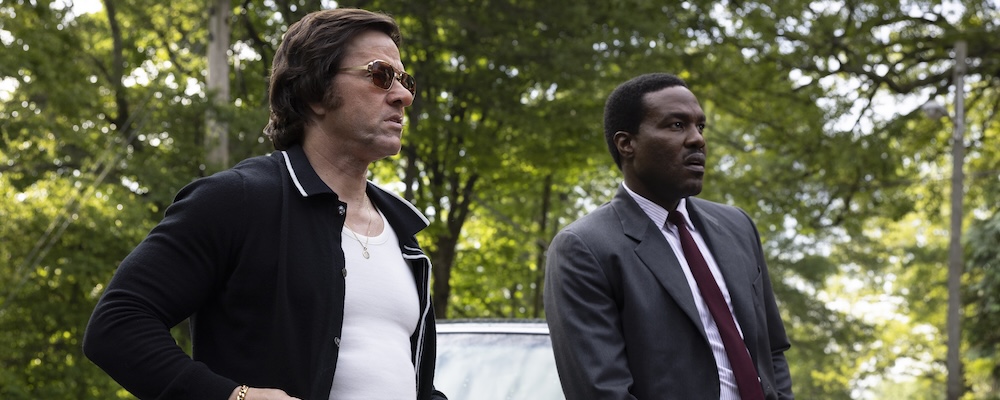
Scarpa (Mark Wahlberg) is who we first meet as he beats a confession out of a man tied to a chair. The year is 1964 and the New York mobster is trying to get information on the famous case of three missing civil rights activists in Mississippi. Cut to two years later and the focus shifts to Wayne Strider (Yahya Abdul-Matteen II), one of the FBI’s few Black agents working out of a Mississippi field office. Strider lives with his wife (Nicole Beharie). Tensions are running high as NAACP leader Vernon Dahmer (Giancarlo Esposito) offers to pay local Black citizens’ poll tax so they can register to vote, which angers local racists. When the KKK firebomb Dahmer’s house, resulting in his death, President Lyndon Johnson demands the FBI make arrests. With no one willing to cooperate with Strider when he gets on the case, field office chief Roy (David Strathairn) calls in Scarpa to help. For a straight arrow agent like Strider, the presence of the crude-talking gangster is confusing, until they start taking names.
Bratton’s approach to this historical period has much in common with past, testosterone-fed takes. The disappearance and murder of the three civil rights workers was most famously explored in Alan Parker’s 1988 film “Mississippi Burning.” As in that movie, the screenplay here by Sascha Penn finds it easier to paint the FBI as overall “good guys,” avoiding the darker politics involving COINTELPRO or J. Edgar Hoover’s racist disdain for Black leaders. Only the Jim Crow Southerners feature violently corrupt cops aligned with the Klan, which was of course the case. Politics are rather simplified in this narrative. Scarpa finds a copy of Martin Luther King Jr.’s “Why We Can’t Wait” in Strider’s car and says he prefers the militant stances of Malcolm X. Scarpa is not some progressive ally of the Black cause. He just likes the tougher counter to King’s nonviolence. When Strider asks what he would do if he were Black, Scarpa immediately answers that he would kill all whites. The material finds more intriguing moments when Scarpa shares about growing up in an Italian immigrant neighborhood with a father being called a “wop.” Deep down the gangster may sympathize with the civil rights cause, or at least with Strider’s anger at the injustice of American racism.
It is tricky material performed well by the two leads. Wahlberg is convincing as a man who lives by a hardened code, despite walking around with a distracting prosthetic nose meant to make him look closer to the real Scarpa. The actor doesn’t exactly have the cleanest record himself, so one senses him genuinely knowing how to channel this personality. He shoots down a racist cop during a stop on a dark country road, where Strider’s safety is truly in peril, and does it like a man showing someone how to properly change a tire. Yahya Abdul-Matteen II is equally good as the more reserved man who has an FBI badge that can feel like nothing in the Jim Crow environment of 1966 Mississippi. Yet, these are strong performances with strange arcs. Scarpa does not undergo a journey so much as get to punch and torture some bad men again. Strider doesn’t start earning his respect until he is willing to bend the law, break some bones and sit back while the mobster threatens to castrate a racist. Be aware Strider is himself a fictional character, and an end title card admits most of what Scarpa is depicted doing is pure speculation.
History is not meant to be learned through cinema, for that we have books and good documentaries. Drama is what matters here. In the style of films like “Hoodlum,” American underworld history gets fuzzed up and rewritten here for the sake of a good movie. In terms of craft, Bratton is a good filmmaker, creating an intense atmosphere with cinematographer Ante Cheng, who turns dark roads into menacing crucibles and knows how to paint with shadows. The result is a curiously mixed bag. A film can be well-made and entertaining while having strange or questionable story results. What are we meant to think of Scarpa? Even if he did indeed do one good deed in helping bring down some Klansmen, he would return to New York to be part of a violent criminal enterprise, working for men gaining wealth from extortion. Strider the FBI agent never talks about this reality, reduced to simply not preferring violence. “By Any Means” as a work of drama has the right to propose its ideas, but it also needs more substance to back them up.
“By Any Means” releases Sept. 4 in theaters nationwide.