
‘The Lowdown’: Ethan Hawke Continues His Quest for Truth in Grittier Second Season of Sterlin Harjo’s Tulsa Noir
Alci Rengifo
Sterlin Harjo’s “The Lowdown” is centered around such an entertaining character that the plot almost seems written out of necessity to give him a landscape. As played by Ethan Hawke, Lee Raybon is a scruffy, literary-minded journalist whose relentless pursuit of the truth frequently leaves him battered, broke and at odds with practically everyone around him. The first season introduced this self-described “truthstorian” through a mystery involving a wealthy Oklahoma family and its disturbing connections to the state’s racist past. Season two finds Lee with a little more recognition for his work but hardly any more common sense, as a new investigation exposes the corruption and inequalities lurking within Oklahoma’s prison system. You want to value this series for keeping alive the idea of wordsmiths as subversive heroes.
Lee begins the season enjoying some recognition following his investigation into the Washberg family. Unfortunately, public acknowledgment is hardly the same thing as personal stability. He remains the sort of man who would rather chase a dangerous lead than appreciate what he has accomplished. When Ginger (Betty Gilpin), a public defender, asks for his help locating a missing client, Lee follows a trail that leads toward institutional corruption and the uncomfortable realities of incarceration. It is precisely the kind of story that appeals to his instincts, even if his methods suggest someone who has never encountered a potentially disastrous situation he couldn’t make considerably worse.
Harjo, who made his mark with the wonderful “Reservation Dogs,” once again demonstrates a knack for finding extraordinary stories in the lives of people who rarely receive much attention from mainstream television. Inspired by the real-life exploits of citizen journalist Lee Roy Chapman, “The Lowdown” has always been about more than solving a mystery. Its investigations uncover the historical baggage that continues to shape American communities, particularly those whose stories have been suppressed by powerful interests. The new season shifts its attention toward the criminal justice system, but the underlying concerns remain consistent. Who gets to tell the truth, who gets to bury it, and what happens to those who refuse to play along?
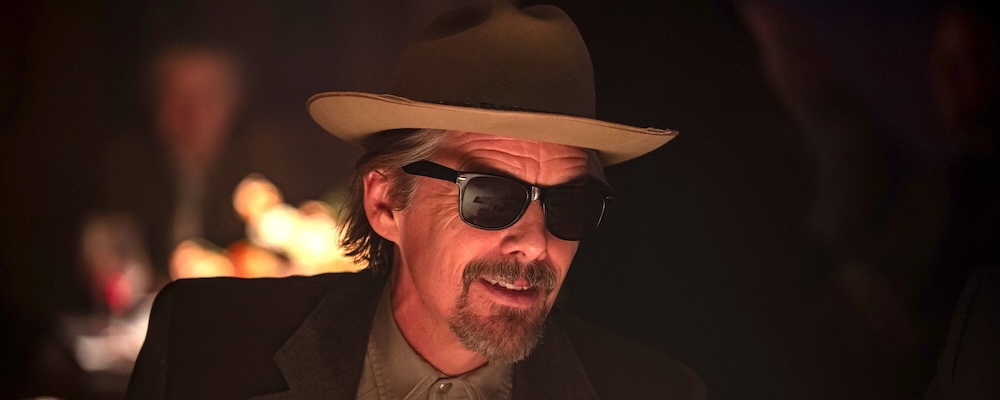
Hawke continues to be the show’s greatest asset. There is a delightful unpredictability to his performance, which combines the literary enthusiasm of a lifelong reader with the physical recklessness of a man who regards getting punched as an occupational hazard. Lee is hardly the conventional television investigator who calmly assembles evidence and delivers a perfectly reasoned conclusion. He is impatient, argumentative and occasionally downright irritating. Yet Hawke understands that the character’s exasperating qualities are inseparable from his determination to challenge people who assume they can get away with anything.
The actor brings a particular comic rhythm to Lee’s encounters with the world. His character can be discussing literature one moment and getting himself into trouble the next, as though the distance between an intellectual debate and a fistfight were practically nonexistent. Hawke has played plenty of troubled idealists throughout his career, but Lee’s mixture of wit, insecurity and barely controlled enthusiasm gives him a distinctive charm. He is not a hero because he always knows what he is doing. He is a hero because, despite all the evidence that he should reconsider his approach to life, he keeps going.
Gilpin adds another appealing presence as Ginger, whose professional concerns bring Lee into the season’s central investigation. Her work as a public defender provides an important perspective on a criminal justice system that looks very different from the vantage point of those trapped inside it. Meanwhile, Tommy Lee Jones appears as Lee’s estranged father, introducing another source of turbulence into the journalist’s already complicated life. Jones brings considerable weight to a series that thrives on colorful personalities, and his arrival allows the show to examine the personal history behind its protagonist’s stubbornness.
Lee may be remarkably perceptive when investigating other people’s secrets, but his own family remains a different matter. His relationship with his daughter, Francis (Ryan Kiera Armstrong), is especially revealing. Lee wants to be a decent father, yet his fixation on exposing wrongdoing continually threatens to undermine that responsibility. He is driven by an admirable desire to make the world less dishonest, but the people closest to him must live with the consequences of his obsession. This contradiction gives Hawke’s performance an emotional dimension that prevents Lee from becoming merely an entertaining collection of bad habits.
What makes “The Lowdown” particularly compelling is the way Harjo connects these intimate frustrations to broader social problems. The investigation into prison corruption is not simply a mechanism for generating suspense. It opens the door to questions about class, institutional power, racism and the treatment of marginalized communities. The series recognizes that injustice rarely exists in isolation. It is sustained by people who benefit from the existing order, institutions that resist scrutiny and histories that are easier to ignore than confront.
Harjo approaches these subjects without abandoning the show’s wonderfully offbeat sense of humor. His Tulsa is a place where eccentric characters, dangerous encounters and seemingly inconsequential details can send a story in unexpected directions. As in “Reservation Dogs,” he finds humor in human absurdity without losing sight of the circumstances that make life difficult for the people inhabiting his stories. The result is a noir that feels less concerned with following a rigid formula than with exploring the peculiar personalities and histories that give a community its identity.
This balance is crucial to the show’s appeal. A series dealing with systemic corruption and historical injustice could easily become an exhausting parade of grim revelations. Instead, “The Lowdown” allows its characters to be funny, frustrating and occasionally ridiculous. Its comedy does not diminish the seriousness of its subject matter; it makes the people caught up in these conflicts feel more recognizable. Lee’s manic energy provides an entertaining counterpoint to the darker realities he uncovers, while the supporting cast gives the story the texture of a community rather than a collection of suspects.
“The Lowdown” season two succeeds because it understands that a compelling mystery is only as interesting as the people caught inside it. Hawke remains an ideal guide through this strange corner of Oklahoma, bringing enough intelligence and humor to make Lee’s reckless decisions entertaining without pretending they are always justified. Jones and Gilpin add welcome dimensions to the ensemble, while Harjo continues to combine social commentary with character-driven storytelling.
In an age when powerful institutions have plenty of reasons to discourage scrutiny, Harjo’s series celebrates the troublesome individuals who refuse to accept the official version of events. Lee is a flawed man, an occasionally maddening journalist and an unlikely crusader whose greatest strength is also his greatest weakness. Watching him stumble into another dangerous investigation remains a pleasure precisely because he never quite knows when to stop. And as “The Lowdown” makes clear, sometimes the people who most need to be exposed are those who have spent years making sure nobody asks questions in the first place.
“The Lowdown” season two premiers Oct. 14 with new episodes airing Tuesdays at 9 p.m. ET on FX.