
‘Do Not Expect Too Much from the End of the World’ Director Radu Jude Counters Claims of Personal Storytelling With Jabs at Routine Shoddy Product
Tony Sokol
Radu Jude’s “Do Not Expect Too Much from the End of the World” exceeds expectations. Not because of its almost three-hour running time, but for everything the Romanian director pushes into every frame. The multilayered, symbol-driven slice of fragmented cinéma verité film might feel too much like Angela’s (Ilinca Manolache) workload, if it didn’t break for laughs.
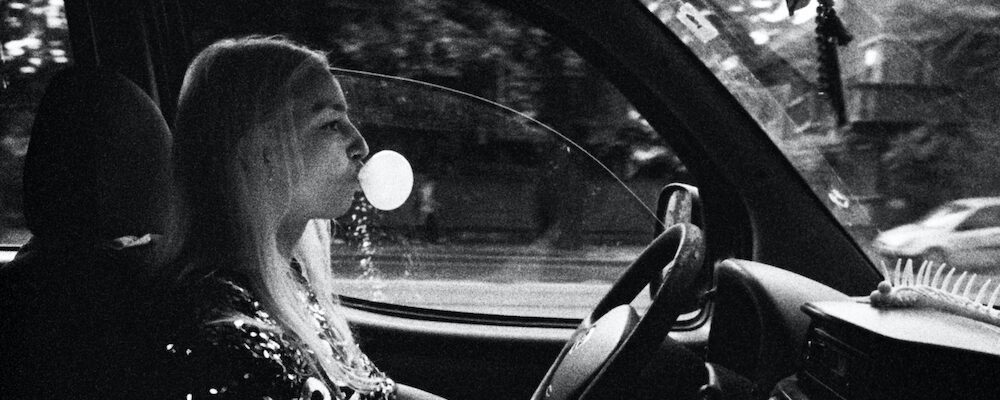
Humor is only a cruel byproduct for the Austrian company shooting a safety-at-work video that blames the Romanian staff for on-the-job disabilities. For the majority of this film, Angela drives around Bucharest auditioning victims to publicly take the blame and quietly pocket a $500 reward. The satire is eviscerating, the mixed media telling is as intricate as Oliver Stone’s “Natural Born Killers.” No one dies at the End of the World. What happens is much more unexpected.
This comes naturally to Radu Jude, whose “Bad Luck Banging or Loony Porn” was labeled provocative, when it was merely unintentionally hilarious. In speaking with Jude, Entertainment Voice found an artist who loves surprises, no matter how much work goes into creating them. It is human nature, before or after the revolution. Bucharest hasn’t changed much, whether seen through a TikTok filter or the fragments of Lucian Bratu’s “Angela Moves On,” made during the reign of dictator Nicolae Ceaușescu’s watchful censorship in 1981. For Jude, cinema is a continuing conversation.
I really enjoyed “Do Not Expect Too Much from The End of The World.” I’m not saying that so Uwe Boll doesn’t beat the shit out of me. I watched those YouTube clips, and have to say Boll is the new cinematic Hemingway.
Yeah, that’s a good one. When the critics made this attack against him, like 10 or 15 years ago, telling him he should stop, I think his answer was really striking, in both ways of the word. Also, I admired that someone goes on and on even if people are taking him down.
How did you get him to do the cameo? A couple rounds?
It was a process. I had this idea that the main character will meet someone shooting something else than what she’s doing. I thought, maybe a feature. But it felt like I was already doing one so I said maybe a short. Then you start thinking, do I take an actor to play a director or invite someone. Of course, the first idea is to invite someone, like, “Hi, bro to have a nice cameo.” Then I remembered the Uwe Bold attitude of resilience, which I deeply admire. We have here our model for this attitude.
I found his email, and things were absolutely smooth. He answered me literally in two minutes after my email, and said yes. In another Zoom meeting, we scheduled an improvisation, and he said yes. Then we scheduled the date of shooting, and he was there that morning. We shot it and that was it. I really believe he’s a great actor.
Tell us about traffic in Romania, and how much of “Do Not Expect Too Much From the End of the World” comes from routine road rage?
Well, quite a lot. There are many reasons, one is connected with the job of the character. Also, in the second part, the man who was crippled because of another car hitting a barrier. It’s all about automobiles. But there is another reason, which I hope is a little bit deeper. I have a feeling that in this car culture and road rage culture in Romania, and traffic carelessness, there’s a lot of things that come together. For instance, the dimension of the desire of people to have cars, which existed before the 1989 revolution. At that time, it was very difficult to have a car. Everything was controlled by this dictatorship. So, the car became a very powerful status symbol.
After the revolution, everybody wanted a car, even 30 years after the revolution, this still remains. It is very important, seeing the bigger the car and the more powerful, the more respected you are in the society at large. And then all the other things, the kind of neoliberal system which took place of the dictatorship where we just throw cars and cars and cars on the road. It doesn’t matter if there’s space or not. The power of the advertising and the lobby of all these industries pushed the authorities not to fund good public transportation, and to push people to buy cars and own cars and [make] the pollution. All these things, with the class system, the incompetence of the authorities in controlling the road rage, etc., come together.
Do you think we find a nation’s true character in how we behave on the road?
I know how it is here. Because I had the residency and lived a few months in Berlin, I noticed that in Germany it is completely different. I don’t want to see this as a kind of national character or temperament. Because I’m not sure I believe that. But I’m sure that you can see that this creates a type of culture. This culture is represented, or is expressing itself.
Ilinca Manolache’s Babita character was created during Covid, and already existed during shooting. But how much of you is an Angela in terms of dealing with the gig economy of indie filmmaking, and how many jobs you have to do to make your films happen?
Well, it’s a tricky answer, I have to be careful what to say. Because on one hand, I can say the film is deeply personal, meaning I started very low in this industry, when I was young, and I did all kinds of small jobs on film sets, in a moment where Romania was opening up to foreign films being shot here, or other types of films, like advertisements, movies, TV series. For me, and for many of us my age, [it was] a good school of learning the trade, if you want. In the old-fashioned way, when directors were not necessarily doing film school, but where we’re working. Like early Hollywood.
On the other hand, when I look back, I see how unregulated it was, how laws of work were not respected, how unions didn’t exist. Still, we don’t have any kinds of unions. Whoever came here, if they had a good, powerful, practical producer, they could push people to the limits, basically. It still happens, maybe in some cases less. Maybe with more money, but it still happens.
From this point of view, yes, it is personal. I encounter these stories or they happened to me, or I was a witness to them, etc. But on the other hand, I’m a bit against this obsession of not only filmmakers, but theater and literature writers to speak about themselves. It’s an inflation of that, there’s so many documentaries about the grandmothers of, or the uncles of, the filmmakers, that I’m fed up with so many stories about some events from the filmmaker’s life. So, I don’t want the film to be considered in this way.
What I have done is take these events to adapt them to today’s world. Here comes Babita, for instance, something like that didn’t exist 20 years ago. These stories symbolize, they are not just “this is what happened to me, let’s make a story because it’s fun or interesting.” They represent, and encapsulate the life of many people here, at least in Romania, in today’s society. This story is these characters.
Romania seems to be a very labor-intensive state, even in the arts. Angelica fighting sleep at the wheel is based on a real-life story of a production assistant. Is the tyranny of filmmaking, the things people are asked to do in the name of art, as treacherous as a tyrannical government?
These kinds of things work in many ways, because maybe a dictatorship can impose this, like it happened in some countries. But also, a government which is not in a dictatorship, and Romania is not a dictatorship anymore, lets things happen, and doesn’t regulate the market, and the workloads, and doesn’t apply the laws. You don’t need a dictatorship for that, you need either a corrupted or incompetent government or rulers. We have both categories. There’s a lot of corruption, and a lot of lobbies, and also ideology. There are people who still consider that to be the essence.
You mentioned things done in the name of art. And, it’s true. That’s, I think, the most troubling thing that sunk in some cases. The name of art. But what I discovered is that in most of the cases, the people who are organizing, or who are hiring the workforce, basically don’t care what they do. When people work on a set, there’s literally very little difference between a masterpiece and shit product, which is made with the same kind of work, basically. Even me, although I was very much interested to learn, so I was very careful, and judged some things to be good or some things not so good. But the work itself is the same. I imagined the welder who doesn’t care if he’s welding an iron bar for a house or for a sculptor. It’s the same work for him.
It’s admirable how you tear off band-aids. Like when you expose prejudice against gypsies or nonchalant anti-Semitism from corporate types.
What I can say here is exactly what one of my heroes, Jacques Rivette, the French new wave filmmaker and critic, said. Rivette used to say that the mission of cinema is to describe. This is what I tried to do. I wanted to create a world or impose something to change the world to change the people. What Rivette says, being very modest, that to describe is enough. I also believe that of course. When you describe, then you have a certain number of tools, and you can use them in different ways. I try to use the tools of cinema, so to speak, in a way to describe better, to make connections, to see things in a collage way, in a patchwork way. When you put one thing next to another, next to another, you create a more complex web of relations. Mathematically more complex.
What’s more fun to you personally, pushing 16-millimeter film stock into new visual territory, or playing with new technology and TikTok filters?
It’s true, one of the things I consciously develop is to “prefer everything,” as someone said. With cinema and not only cinema, whatever the thing is, when you really pay attention to something, it becomes much more interesting. For instance, the aesthetic of the mobile phone, the texture of the iPhone image that Babita is doing that we shot with an iPhone was quite different to that before making the film. Making the film and paying attention to that and working with that, brought me to see much more into it than before. I see this through every aspect of, not only a filmmaker, but of life. Sometimes it can happen with a street that you’ve visited a hundred times and you didn’t pay attention to it. Sometimes it can happen with a book. Sometimes it can happen with technology. When you work with something, when you pay attention, you are rewarded. I think this is the frame of mind. Of course, in many cases, some preferences appear, but I tried to be open to everything and to treat everything equally in a certain way.
Rita Lazar reprises her role as Angela. Are the Romanian actors of that generation different to work with than the ones who are working now?
She’s working a lot in theater. She’s a theater actress, and I appreciate her very much. Otherwise, she has her moral standards, and aesthetic standards, because she knew my films, and she said, “I’m coming to your film if you promise there is no profanity in it, and no vulgar things.” I said, yes, there won’t be any profanity and vulgar things, but of course, it was a trick I played on her. She saw the film and she was angry, but then we became friends. Now she likes the film, and she’s even nominated to the National Film Boards as the Best Supporting Actor.
I loved the unrelenting camera at the end. How much of that was improvisation? Was it really raining?
At the beginning, I wanted to make it much more complex, with a lot of choreography. I did some rehearsals and then realized I’m not good at that. Then I told many of the actors to stay behind the camera, and they were not happy because we rehearsed a lot with them in front of the camera. Then I had this idea, everything went smoothly and we shot in two days. There were moments of improvisation, because I let everything be very loose, especially rhythm wise. And, the rain came unexpectedly.
“Do Not Expect Too Much from the End of the World” releases March 22 in select theaters.