
‘Heart of the Beast’: Brad Pitt and His Riveting Canine Companion Give David Ayer’s Survivalist Adventure Dimension
Alci Rengifo
David Ayer’s “Heart of the Beast” brings together two artists who represent a particular kind of masculinity, but pulled off with a nice sensibility embodied by its canine scene-stealer. For Brad Pitt, who has been overshadowed by uncomfortable personal headlines, this is one of those roles that almost feel like a curious form of self-therapy. Ayer’s own career as a filmmaker has been marked by hits and misses that all channel plenty of violence, disturbed psyches and a somewhat despairing view of the world. While on the surface this is a movie about a guy lost in the woods, Pitt and Ayer bring more to it, helping us forgive its less convincing moments.
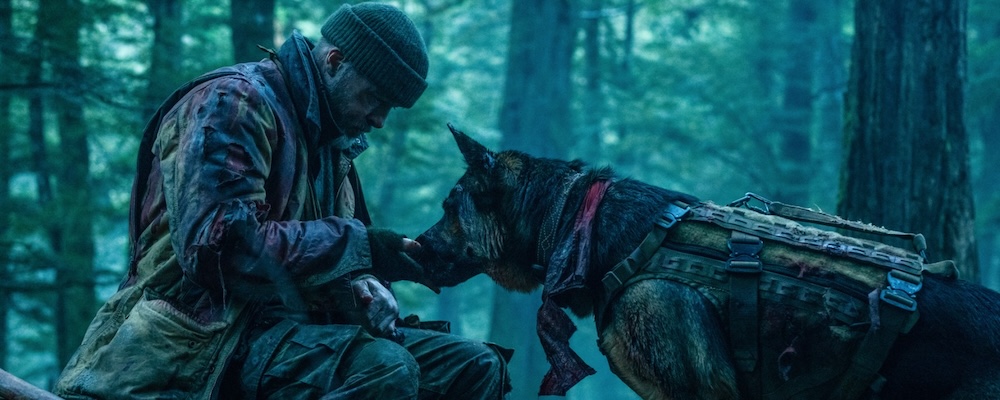
The setting of Cameron Alexander’s screenplay is the stunning Alaskan wilderness, where former Special Forces officer James Belmont (Pitt) enjoys camping out and fishing in solitude with companion and German Shepherd Odin. The loyal dog has titanium teeth and a prosthetic leg after having served as a combat dog next to James. Flashbacks show us the two facing dangerous situations in what looks like Iraq or Afghanistan. Both are haunted and Odin suffers from PTSD nightmares, with James soothing him when he wakes up. Another camper, a former prospector (J.K. Simmons looking like he belongs in another century), bumps into the pair and proves he is a friend, eventually sharing a Belgian ale over a campfire. In the morning the prospector is gone and James and Odin fly off in James’ small airplane. The veteran suffers a heart attack while in the air and they crash. Odin is slightly injured, as is James, and the only way to get to the nearest road is by clearing fifty-eight miles.
Some filmmakers can get lost in a certain style and if they’re lucky, find refreshed growth by switching to new narrative choices. As a director, Ayer’s catalog is full of tales of big city violence, including good films like “End of Watch” and misfires such as “The Tax Collector.” His last two movies were Jason Statham action vehicles. “Heart of the Beast” marks a return to the kind of broader storytelling evident in the last production Ayer worked with Pitt on, “Fury,” a gritty revisionist take on World War II. “Heart of the Beast” has a visual scope where cinematographer Mauro Fiore captures Alaska with sweeping vistas that recall films like Lee Tamahori’s “The Edge.” Jared Michael Fry’s score also nods at the orchestral style of past survivalist thrillers. Yet, the general tone is not some painterly take on the wilderness, but evoking it as a lonely place for a lonely personality. Intriguingly enough, Ayer’s apparent philosophy of life as a terrain of struggle and predators fits well. After surviving the crash, James and Odin come across scenes meant to showcase the battle of existence, such as a pack of wolves attacking an elk. The only flaw here is that unlike days of old, the animals are all clearly CGI, even a big grizzly bear that corners our heroes.
You could say Ayer celebrates an old-fashioned macho ethos where most of his characters tend to be men who practice or are haunted by violence. They live by particular codes of conduct. “Heart of the Beast” is surprisingly subtle, plausibly using James and Odin’s background to explain why they can take the pain and endure. The physicality of the movie is engrossing. Sure, James has those scenes where he can re-set a bone and do other maneuvers on his own, but our minds never question it. It is surprising to realize how one doesn’t even notice that James apparently has no cell phone. Ayers also avoids cliché villains to throw at the travelers. James and Odin are facing off purely with the elements and ecosystem. There is enough gut-wrenching suspense when they have to cross a perilous log, avoid drowning or face ravenous, roaming wolves.
Dramatically, what works quite well is that Pitt’s approach is not to turn James into a superhuman personality. He comes ready with supplies and has the outdoorsman’s sense of certain things, yet there is also genuine fear in the performance. Is Pitt channeling his recent personal battles here? The loneliness and scarred emotions are palpable along with a need to heal. Odin, played by the dog Uber, also evokes a tenderness and weariness achievable with great editing, so much attention must be given to editor Dody Dorn. Pitt only raises his volume when the situation becomes truly urgent, but the rest is done at a reflective pace. With his furry co-star, the actor manages to evoke that special bond only those who truly love animal companions can recognize. To see Odin get injured means his emotional world is getting shattered. The closing moments are a wonderful testament to friendship, not sticking to a shallow idea of man and animal. For Pitt and Ayer this is a strong return to form, signaling that they may have plenty of good stories left to tell.
“Heart of the Beast” releases Sept. 25 in theaters nationwide.