
‘Fjord’: Sebastian Stan and Renate Reinsve Bring Piercing Emotional Force to Cristian Mungiu’s Compelling Drama About Discrimination
Alci Rengifo
In most stories about prejudice, it tends to be the conservative forces who rally against some progressive threat. Cristian Mungiu’s “Fjord” operates with a striking, deep sense of balance in asking us to consider discrimination on a wider plain. Any group can find itself falling into an extremist view, ready to reject “the other.” Mungiu sets the story in Norway with a conservative Christian family who become the persecuted. Like Mungiu’s previous work, it is an intelligent, elegantly constructed drama. You could even say it is a psychological thriller in the purest sense of the term. Its tension comes from the clash of worldviews, and how mere perceptions can set off a firestorm.
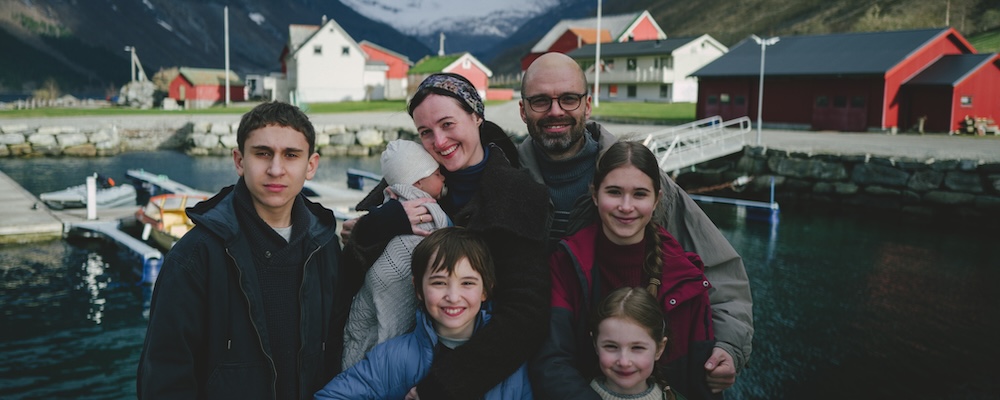
Renate Reinsve, one of the best international actors now working, and Sebastian Stan disappear in their roles as Lisbet and Mihai, who have recently moved to a rural town in Norway from Romania. Lisbet is Norwegian while Mihai is Romanian, which already raises some eyebrows subtly, since in this corner of Europe the east is still seen as backwards. They have five children, including teenagers Ella (Vanessa Ceban) and Emmanuel (Jonathan Ciprian Breazu) and an infant. While they openly practice their Christianity, attending church on Sundays, holding congregation gatherings at their home, etc., they are also not trying to aggressively convert anyone. At the hospital where Lisbet works, the rules are clear on not mentioning religion to grieving families unless they ask for it. At the high school where Mihai does IT, teachers tell him in a friendly way to not play hymns on a keyboard. And then one of the school employees, Frida (Lisa Loven Kongsli), thinks she overheard Ella and Emmanuel mention being hit by Lisbet, and a bruise on Ella’s shoulder raises even more suspicion. A report is made to Child Services, who begin investigating Lisbet and Mihai, and take away their children into temporary foster care.
“I’m always starting from a preexisting story and everything you see in this film corresponds to a story I investigated. I talked to a family in Norway and little by little I noticed a pattern. It concerns conservative families moving to Scandinavia, considered a pole of progressivism, and you can see a clash of values when these conservative families move there,” is how Mungiu described to Entertainment Voice the inspiration behind the film. Himself a Romanian, Mungiu’s films have grappled with repression and prejudice both in his nation and beyond. In 2007 he won the Palme d’Or at Cannes for the wrenching “4 Months, 3 Weeks and 2 Days,” about two women in 1980s Romania attempting to get an underground abortion. His excellent “R.M.N.” from 2022 dealt with the rise in anti-immigrant paranoia in Eastern Europe.
In that spirit, “Fjord,” which also took the Palme d’Or at this year’s Cannes fest and is a clear frontrunner for the Best International Feature Oscar, poses the idea of what tolerance truly means. Lisbet and Mihai are not necessarily “likeable” personalities, at least for any liberals in the audience. They have that reserved manner of religious conservatives, though they don’t mind that Vanessa makes friends with Noora (Henrikke Lund-Olsen), the stepdaughter of school principal Mats (Markus Scarth Tønseth). Noora is a rebel who stresses out Mats, a man who prides himself on being secular and rational, yet easily loses his temper with the teen. When Noora comes to visit, Mihai cheerfully explains Biblical stories to her and his own children, having them sing Christian songs in front of her as well. Yet, one doesn’t sense it is a self-righteous display of their faith, just a presentation to see if the girl might ever be intrigued. Some may no doubt find such behavior annoying, but in a free society it isn’t a crime.
The rich complexity of Mungiu’s screenplay becomes even more evident when in her despair Lisbet reaches out to Mats’ wife, Mia (Lisa Carlehed), a lawyer, and asks for her to represent the couple in court. This happens after another lawyer admits she doesn’t want to represent such a conservative family. In particular, she is unnerved by how Mihai is clearly the head of the household, though not in an abusive way. Like the Iranian films of Jafar Panahi, there is a wonderful humanism colored by particular outrages. The world is not so black and white. Lisbet clearly loves her children and would die for them. When she learns her baby will also be taken away, her tears are more than believable. In court the prosecution gradually bases most of its case on the family not fitting into a progressive society. Mia may know little about religion, but she defends the couple with the conviction of doing what is morally right. The cinematography by Tudor Vladimir Panduru is masterful in its cold, widescreen loneliness, as if to capture how prejudice breeds even more easily where communities are encased together away from the wider world.
For Renata Reinsve and Sebastian Stan, these are stellar performances displaying their capacity to fully disappear in their roles. Reinsve has been maturing impressively as an actor and has come so far from her 2022 breakthrough, “The Worst Person in the World.” Stan as well finds neigh range here. Together they form a couple that feels so organic and committed to their way of life. We would root so easily if it were the other way around, but there are all different kinds of people in the world and a challenge in the modern world is how to be free while respecting the differences with our neighbors. “We would expect more tolerance and inclusion in the modern world,” says Mungiu. “It would be good to be humble and admit you are not always right, and to double check your opinions and engage in dialogue with others. That is how we construct a society inclusive for everybody.”
“Fjord” releases Oct. 9 in theaters nationwide.