
‘Sense and Sensibility’: Daisy Edgar-Jones and George MacKay Are a Dreamy Pair in Georgia Oakley’s Understated Jane Austen Adaptation
Sandra Miska
Filmmaker Georgia Oakley travels back a great deal further in time for “Sense and Sensibility,” the follow up to her acclaimed feature debut “Blue Jean,” about a closeted teacher in 1980s England. Oakley’s “Sense and Sensibility” is a dreamy adaptation of Jane Austen’s 1811 novel on young love and sisterhood. Daisy Edgar-Jones leads a strong ensemble cast as Elinor Dashwood, the oldest of three sisters who, along with their mother (Caitríona Balfe), face hard times after the death of their father. It is during this transitional period that introverted Elinor and her more free-spirited sister, Marianne (Esmé Creed-Miles), both find reasons to hope when they catch the eyes of three very different men: good guy and aspiring preacher Edward Ferras (George MacKay) for Elinor, and rakish John Willoughby (Frank Dillane) and stoic Colonel Brandon (Herbert Nordrum) for Marianne.
No sooner is the Dashwood patriarch in the ground before his oldest child, son John (Tom Brooke), and John’s snooty wife, Fanny (Stacy Martin), take ownership of the large family home. Fanny is especially resentful towards her husband’s stepmother and half-sisters, and they are treated like unwanted guests before Mrs. Jennings (a warm and cheery Fiona Shaw), the older Mrs. Dashwood’s jovial cousin, offers to rent a cottage to her and her girls for a minimal fee.
A bright spot during this period is the arrival of Fanny’s brother Edward, who almost immediately forms a bond with Elinor, but there is something holding him back, and not just his sister’s disapproval. Meanwhile, Marianne enjoys a more passionate flirtation with local hot guy Willoughby. She also attracts the attention of the older Colonel Brandon, who seems dull and dispassionate compared to his competition, but still waters run deep here.
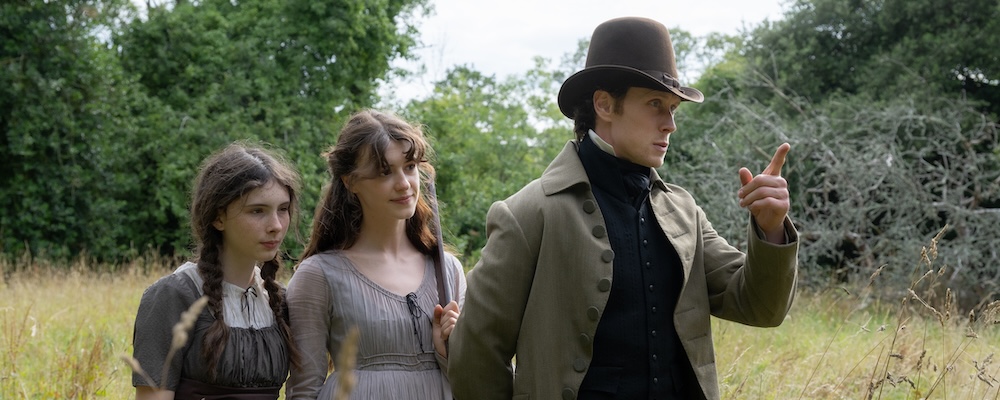
Of course, Austen fans will not be able to watch this “Sense and Sensibility” without comparing it to Emma Thompson’s delightful 1995 adaptation. While this newest film never quite captures the sweeping, epic feeling of this predecessor, Oakley makes her own mark here, and we can appreciate her interpretation of the novel for what it is. Her film is beautifully shot, making use of a more subdued color palette and enchanting nature settings. The costumes are also simpler and more natural than what we are used to seeing in films set in this period.
The filmmaker also does not shy away from some of the more grittier plot points, such as a duel in the third act. Oakley also puts great emphasis on the bond between the sisters, which is wise, as Edgar-Jones and Creed-Miles have amazing chemistry as Elinor and Marianne lean on each other for emotional support. Bodhi Rae Breathnach, who plays youngest sister Margaret, also shines.
While Oakley and screenwriter Diana Reid are mostly devoted to the source material, Austen purists may take issue with certain tweaks. Colonel Brandon, who is about 20 years older than Marianne in the novel, is closer to her age here, probably to make the pairing more palatable to younger viewers. But the one major drawback to this adaptation is that it sorely lacks Austen’s biting social satire. For example, Lucy Steele (Ceara Coveney), the silly social climber who is Elinor’s rival for Edward, is a colorless one-note character here. The subplot in which Fanny befriends her to only have it blow up in her face is sadly missed.
But this “Sense and Sensibility” is a worthy addition to the list of Austen adaptations to watch on a lazy day. Not only is it wonderful to look at and strong on the sisterhood, it also features a stellar cast. Edgar-Jones and MacKay, two of the most interesting and versatile young actors working today, are especially a treat to watch. Everything leads to a moving, emotionally-charged climax that would make Miss Austen proud.
“Sense and Sensibility” releases Oct. 16 in theaters nationwide.