
‘Fatherland’: Thomas Mann’s Return To Post-War Germany Becomes a Powerful Reckoning With the Past
Alci Rengifo
How will those who support crimes against humanity today answer when the reckoning arrives? That question burns in the subtext of Paweł Pawlikowski’s elegant “Fatherland.” It is the third film in the acclaimed Polish director’s trilogy that explores the fractures of modern European history through compelling, personal stories. Here, he chooses as his subject the historical figure of Thomas Mann, as the great German writer visits his homeland after years in exile following the rise of the Nazis and World War II. Pawlikowski does not seek to make another biopic. The film is about this moment in Mann’s life that becomes a powerful representation of a world in ruins, when old ideas seem to suddenly crumble after a country has exposed the worst of humankind.
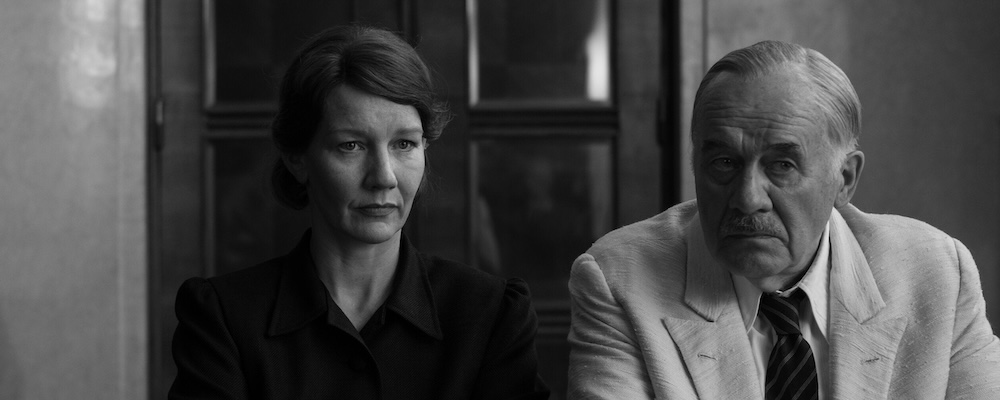
The film opens in glorious black and white, not on the author, but on his bohemian son, Klaus (August Diehl), who is looking depressed in a Cannes apartment while speaking on the phone with sister, Erika Mann (Sandra Hüller). She is inviting him to join her and their father on a trip to Germany. It is 1949 and Thomas Mann (Hanns Zischler), Nobel Prize-winning author of “The Magic Mountain,” is traveling to Frankfurt to receive the Goethe Prize and lecture on the great writer. He also wishes to go to Weimar, where Goethe wrote his most essential works. This is contentious because following the war Germany has been divided between the capitalist West and Soviet-dominated East. Upon arrival, Erika finds anonymous hate mail accusing Mann of betraying his “fatherland,” presumably for pretending that he can rise above such divisions. Instantly there is tension, whether at press conferences where journalists wonder why Mann exiled himself to California instead of riding out the war, or parties where old acquaintances now pretend they never supported Hitler. As Ericka, a leftist looked on with suspicion by U.S. officials, grapples with these developments Mann keeps his intellectual composure. He will not budge on the idea of crossing into East Germany.
Pawlikowski has proven himself a filmmaker who can make great art out of a delicate connection between lives within the greater canvas of history. He won the Best International Film Oscar in 2013 for “Ida,” about a Polish nun who discovers her Jewish roots in a community keen on forgetting its role in the Holocaust. He followed it in 2018 with “Cold War,” a gorgeously tragic romance about a Polish composer and a slightly younger singer divided by Stalinism, the Berlin Wall and sheer human folly. As with “Fatherland,” they were also shot in luminous gray scale by Łukasz Żal, surely one of the world’s great cinematographers. Fittingly, this new chapter also won Pawlikowski a Best Director award at this year’s Cannes Film Festival, since it comes back to the very ruins of the conflict Europe continues to define its ongoing evolution by.
Shot in a way that evokes the very aura of memories, “Fatherland” also transcends its setting because its themes are quite universal. We are grappling with them now at a time when people gravitate towards extreme parties and politics, or support murderous conflicts. When Mann and Ericka are driven through streets where buildings are still rubble, it works as a metaphor for a world after fascism. The screenplay by Pawlikowski and Hendrik Handloegten does not dance around the issue. When Mann is approached at a party by the grandchildren of the composer Richard Wagner, whose music was admired by Hitler, they praise him and ask for help resuscitating the Bayreuth festival meant to celebrate Wagner’s operas. With pure class, Mann informs them their mother, a Hitler supporter, should be in jail and Bayreuth torn to pieces. Ericka is even more upfront when her ex-husband appears and tries to claim he was never a Nazi, despite helping have Klaus’ writings, such as the novel “Mephisto,” banned. Feeling the claustrophobia of the place, Ericka later yells at a group of drunks singing down the street, calling them fascist scum.
Against such anger and pain, Mann, played with serene intelligence by Hanns Zischler, seems to use culture like a shield. He does not side with either capitalism or Marxism in this world where firm political ideologies continuously fail. Only the intellectual art of seeking and questioning appears to make any sense. Being older, having lived through the chaos of World War I, the Weimar Republic and the rise of Hitler, Mann can ease the atmosphere at the East German border by giving a young soldier one of his cigars with a smile. Both the West and East try to claim him as their own, making lavish offerings for public posts. A Communist Party official promises he would just function as a cultural symbol and can spend all his time writing. There’s a bit more sincerity from a jolly Soviet general who has a genuine love for literature, quoting Goethe with Mann. Yet, these political operators can only go so far. Mann wanders gardens with them, where old status takes on a haunting quality, representing an old Europe that is now decimated.
Sandra Hüller’s performance becomes the true anchor of this film. Hüller’s Ericka has great intelligence but is less willing to compromise with a society claiming to move on. In a sense she also becomes Mann’s conscience, challenging him to accept that being emotional about a catastrophe is just as valid as being analytical. They feel like a real family connected through love and also conflict. You don’t need to know everything about the Manns, we get just enough through the rich subtlety of the dialogue. Though, for more there is Colm Tóibín’s masterful novel “The Magician,” which covers in sweeping style Thomas Mann’s entire life. “Fatherland” doesn’t even bother to pretend to dissect any of his renowned novels. At only eighty-two minutes, it is almost a vignette that has much more to say than a bloated opus. When Mann lectures about Goethe the audience looks enraptured, but a particular ghost stares back at him from the audience. We can pretend to shut off the world, but in the end, we are all the victims of history, defined by our time if not scarred by it.
“Fatherland” releases Oct. 23 in select theaters.