
‘The Social Reckoning’: Aaron Sorkin’s Facebook Takedown Meanders Through Strong Performances That Preach to the Choir
Alci Rengifo
Aaron Sorkin feels like he’s preaching to the choir with “The Social Reckoning,” reminding us that social media has adverse effects and Mark Zuckerberg embodies the ambitions and dangers of tech tycoons. One glance at the world scene and there is little doubt of the sort of proto-fascism Zuckerberg and his fellow tech lords have helped propel. No longer portrayed as the darkly complex youngster of David Fincher’s “The Social Network,” which won Sorkin a Best Adapted Screenplay Oscar, Zuckerberg here is more of a symbol. This is being somewhat billed as a sequel to that 2010 modern classic, but it feels fully detached. This is not only because sixteen years have passed, with much happening since then. It is in Sorkin’s own particular approach, posing valid points while making others with somewhat lightweight brushstrokes. The result is a movie that never quite coheres into a satisfying whole.
Sorkin opens with a DUI stop during which a woman, Kayleigh (Portia Doubleday), starts berating two police officers on her phone, one Black and the other Latin, for supposedly targeting her for being white. The viral video shocks Frances Haugen (Mikey Madison), a Facebook junior product manager who recognizes the woman as an old school friend. We then meet Jeff Horwitz (Jeremy Allen White), a Wall Street Journal reporter tasked with covering tech despite not knowing how to operate his car’s GPS. All this is taking place in 2019. Trump’s first term grinds on and there are barely hints of an emerging virus outbreak in China. When Frances’ team present some ideas to Facebook CEO Zuckerberg (Jeremy Strong) to quell or at least help monitor harmful content or misinformation, he lashes out at the idea of losing one percent of user engagement. The tech billionaire is also tirelessly preparing for an upcoming congressional hearing, doing mock sessions on a set modeled after the Capitol’s inner chambers. For Frances, the only viable option to bring about any meaningful change could be passing along what she knows to a journalist like Jeff.
Sorkin’s main obsession in “The Social Reckoning” is the way social media can have negative social effects. As in his high-spirited work for TV like “The West Wing,” the politics are somewhat simplified to general talking points. For Frances, her friend’s viral video is evidence of Facebook’s radicalizing potential, since Kayleigh used to be so liberal. Surely, there must be more too it. Social media no doubt exasperates the current political landscape, but Timothy McVeigh and the Columbine shooters didn’t need Instagram. Famous writers like Christopher Hitchens switched from left to right after 9/11. To be clear, Kayleigh is herself a fictional character, so Sorkin is creating conduits for a film that can feel like a thesis essay. Without a doubt Zuckerberg has allowed his creation to become a platform for neofascist groups to spread their agendas (while pro-Palestinian voices, for example, are infamously censored). Yet, Sorkin seems to reduce our current situation only to the rise of tech as a misinformation tool, never exploring the various movements or ideas that were already around but now have a convenient syringe into the national psyche.
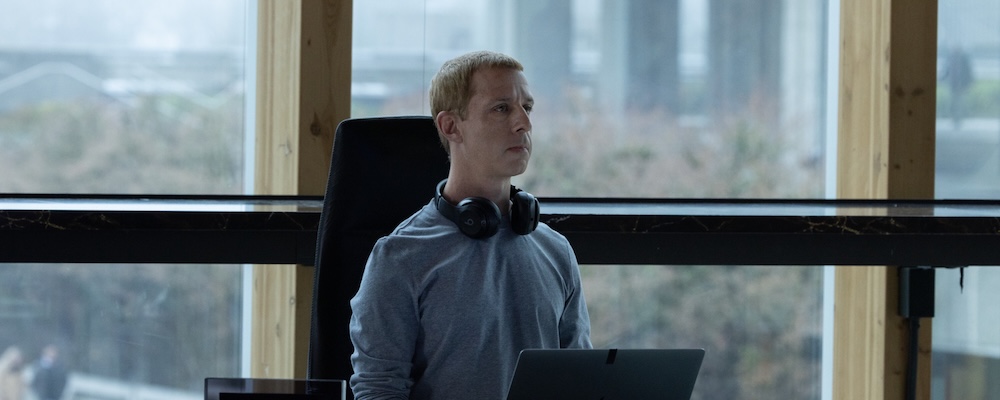
Inevitably, the most fascinating character is Zuckerberg, played by Jeremy Strong like a combination of his perturbed media heir from “Succession” and perverse narcissist Roy Cohn of “The Apprentice.” One can sense Strong channeling an older idea of Jesse Eisenberg’s performance from “The Social Network,” making Zuckerberg still speak in a rapid fire cadence, like a brain always speeding ahead. He sits like a statue behind his desk at headquarters or during rehearsals for congress, intimidating others with an “I’m smarter than you” feel. He barely cracks a smile when giving company announcements on new updates to make algorithms more addictive. A major difference with the Fincher feel is that in “Social Network,” Zuckerberg was the main character, and through him we see Facebook evolve out of a need to overshadow the jocks, snipe at the world or fuel an unhealthy obsession with ex-girlfriends. How all the power and wealth warped his psyche further is an important story, which Sorkin decides to ignore and keep Zuckerberg more to the background. We learn nothing new about the man, fascinating details are left out.
For most of “The Social Reckoning,” Sorkin feels to be chasing after the kind of inspirational cinema that feels from a more innocent time. Cinematographer Jeff Cronenweth lensed “Social Network” but doesn’t go for the same gothic, baroque tone here. Sorkin’s visuals are more apt for TV movies. The music by Alexandre Desplat has nothing in common with the Oscar-winning electronic ambiance of Trent Reznor and Attics Ross. Desplat throws in a lot of soaring horns that make us feel an American flag will cover the screen at any minute. Frances and Jeff are turned into journalistic heroes, with a few lines nodding at how print journalism is also under threat. Yet, unlike classics such as “All the President’s Men,” Sorkin is confronted by the fact that there is no Watergate as of yet. Jeff’s eventual reporting in a series of acclaimed articles known as “The Facebook Files” certainly contained much vital, insightful revelations. By now, however, much worse has been revealed or is suspected. At least with Woodward and Bernstein, President Nixon eventually resigned from office. As a closing title card informs us, soon after Frances testified before Congress, Facebook changed its name to Meta and has only grown less regulated.
Of course, Sorkin could be hoping the film works as a warning. The crescendo of his script is the Jan. 6, 2021 riot where Trump supporters stormed the Capitol. Intriguingly enough, for such a concerned liberal, amid repetitive shots of rioters storming the police and trying to break down barricades, never once does Sorkin show footage of Trump. Instead, we see Zuckerberg hunkering with his team as they insist he shut down pages or information flows connected to groups involved in the riot. Is Sorkin suggesting that without Facebook such an event as Jan. 6 would never have occurred? You could argue a flamethrower like Trump could have provoked the same crisis without necessarily needing social media, though it did help. The line between the rise of a right-wing populist like Trump and a tech baron like Zuckerberg is key to understanding the evolution of American society over the last decade. Sorkin spells out so much else in this movie, but shies away from that.
Overall this is a movie with some good actors working well with the material. Mikey Madison gets to do a more subdued role after winning the Oscar for a hyperactive delivery in “Anora.” Here she is the office worker discreetly asking questions. Jeremy Allen White is his usual brooding self, not so much building a character as a walking question machine for everyone he encounters. The villains simply become more entertaining, like Billy Magnussen as Teddy Marks, a media relations executive for Facebook who can give evasive answers with a subtly menacing smile. As with Zuckerberg, we could definitely spend more time with him. “The Social Reckoning” has a rather ironic title, because in a sense there has been no reckoning. Zuckerberg and his ilk only seem more unstoppable in a drive to reshape the world in a way that is detrimental to us all but not for their stocks. Sorkin is desperately seeking heroes in his story for a tale that has few of them, and where the bad guys still hold most of the cards.
“The Social Reckoning” releases Oct. 9 in theaters nationwide.