
‘Street Fighter’: Messy Arcade Game Adaptation Drops Confused Kicks and Cheap Nostalgia
Alci Rengifo
Two movies are punching at each other in “Street Fighter.” One is a decent anime entertainment and the other a shallow, juvenile exercise in pure dumbness. Depending on your preferences, the better movie will keep getting shoved aside by the needless one for two hours. To be fair, we shouldn’t expect a serious film based on the ’80s Capcom arcade game. Filmmakers who have tackled the material before naturally veered towards satire. What Kitao Sakurai is trying to do with this new version is hard to say. Is the idea here to make fun of macho action movies by becoming an obnoxious macho action movie?
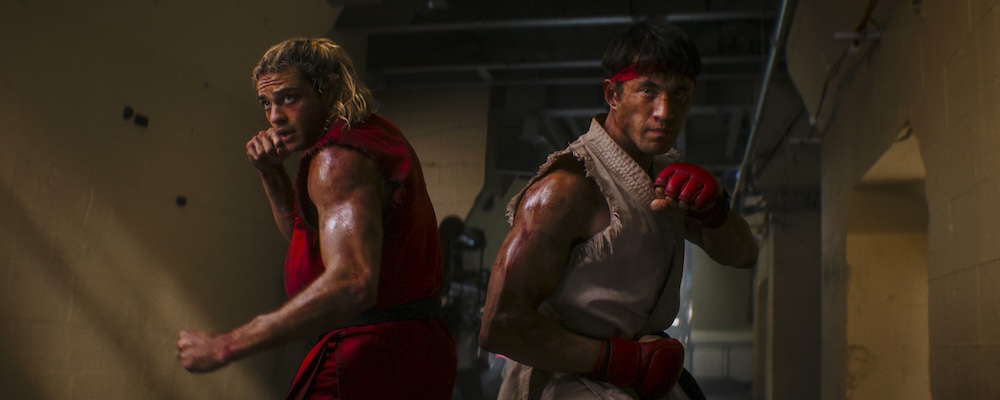
“Street Fighter” opens with the 2D animation, courtesy of the studio Titmouse, Inc., revealing the origins of American fighter Ken (Noah Centineo) and Japanese fellow fighter Ryu (Andrew Koji). They both train under the overbearing sensei Gouken (Don Lee). In 1987, Ryu won the first ever World Warrior tournament. This led to Ryu being nearly destroyed by the dark powers of Akuma (pro wrestler Joe “Roman Reigns” Anoa’i), the demonic brother of Gouken. Ryu basically became a reckless celebrity, as we see in MTV-styled news clips. Now six years later, Ken is still fighting, but as a sort of roving show managed by shameless Dan Hibiki (Andrew Schulz). Ryu, meanwhile, runs a noodle stall. Then, Interpol agent Chun-Li (Callina Liang) approaches the former friends with an offer to fight in the new World Warrior tournament. Her real goal is to infiltrate the regime of warlord Lord M. Bison (David Dastmalchian), who wishes to harness a force known as “Psycho Power” from the tournament’s champion.
“Street Fighter” is mindless entertainment, which almost feels inevitable since the video game is an ‘80s remnant that feels designed to function solely as an interactive escape. Steven E. de Souza’s 1994 “Street Fighter” movie at least tried to turn the material into a satire jabbing at militarism and the kind of images that were coming out of the Balkans at the time. It’s not a great film by any means, featuring Jean-Claude Van Damme as the flat lead and a scene-chewing Raul Julia as Bison, this being the actor’s last major role before passing away. Sakurai feels more confused about his take, going for both semi-satire and pure nostalgia indulgence. The live action sections are shot by cinematographer Ken Seng with a strange lack of real color and more like digital video from the aughts. Sakurai and T.J. Fixman’s screenplay then tries to get away with the kind of testosterone humor that feels written by horny teens. Maybe that’s the point? Men call each other “tittie man” and female characters judge each other’s thighs.
What truly makes “Street Fighter” a garbled experience is that as a production it’s simply all over the place. Most of the dialogue is shouted, only to be interrupted by ridiculous fights. Most of the time it is just incomprehensible. For the World Warrior tournament two teams are formed featuring colorful personalities who really could only exist in a ‘90s video game. On the “good side” we get American G.I. Guile (Cody Rhodes, another pro wrestler) and the mystical Dhalsim (Indian martial artist Vidyut Jammwal). These two are walking stereotypes with cartoonish wardrobe and hair. Bison’s fighters include Balrog (rapper Curtis “50 Cent” Jackson), a boxer, Blanka (Jason Momoa), a green monster looking for his mommy, and Vega (country act Orville Peck), who wears a white mask and has claws. They spend most of the movie trash talking (or yelling), brawling, and then trash talking some more. 50 Cent appears to be having a fun time. Meanwhile Bison walks around his red fascist outfit, saying cliché dictator lines or getting Psycho Power pumped into him so he can take over the world, or something.
Sparks of dramatic potential barely appear when Ryu and Ken try to patch up their friendship. Noah Centineo deserves attention for his efforts, since he’s decked with long hair and wardrobe that makes him look like an ‘80s metal reject. Maybe that’s what the director was going for. “Street Fighter” plays like a less focused version of this year’s “Masters of the Universe,” which was not a hit but knew how to satirize its source material while having a good time. The final battles of “Street Fighter” rush by in a clunk before we get a bizarre, half-formed ending that feels like an abrupt stop, as if this were the beginning of another episode on a streamer. A bonus scene returns to the much better anime film, showing off all the color and potential if this had been the whole format of the movie. So strange that we know there could have been a much better “Street Fighter,” because it’s hiding there in plain sight.
“Street Fighter” releases Oct. 16 in theaters nationwide.