
John Malkovich Is Magnificent as a Haunted CIA Operative in Martin McDonagh’s Sublime ‘Wild Horse Nine’
Alci Rengifo
Hollywood spies are such cartoons. In the real world, one has to wonder how such a life of deception and possible murder weighs on a person. When looking at the aftermath of an illegal war or the overthrow of a government, do those involved simply salute and say it was their duty? Martin McDonagh’s “Wild Horse Nine” is a unique buddy comedy, in how it tackles the aftershocks of recent American history, in the sense of our continent. On Sept. 11, 1973, the U.S. backed a military coup against the elected government of Salvador Allende in Chile. In the cutthroat world of the Cold War, the Nixon administration feared the idea of a successful, democratic Marxist government. McDonagh uses this history as backdrop for the haunted souls of men operating in the shadows.
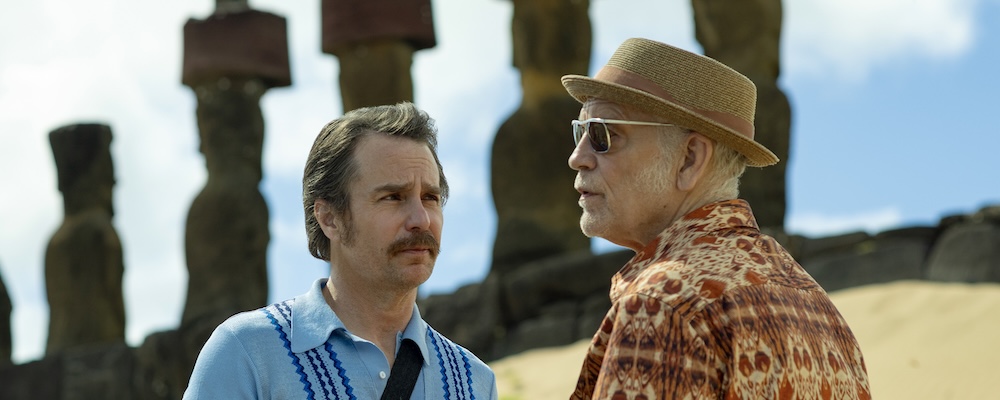
Those men are Chris (John Malkovich) and Lee (Sam Rockwell), two CIA operatives in Santiago months before the coup is to take place. Chris is the older agent in his seventies, with experience in past CIA-sponsored coups in Guatemala, Congo and the unsuccessful attempt to overthrow Fidel Castro at the Bay of Pigs. While being filmed by Lee, Chris also suggests “Dallas” was a successful operation, meaning the JFK assassination. He has also developed a habit of telling civilians sensitive information out loud. While sitting at an airport with Lee to catch a plane for Rapa Nui (or Easter Island, as he prefers to say it), Chris coldly tells two Chilean college students, Monica (Mariana di Girolamo) and Alicia (Ailín Salas), that their beloved President Allende will soon be dead. The veteran operative is also planning a memoir, which worries superior MJ (Steve Buscemi). As plans for the coup advance, Lee has been tasked with grabbing hold of whatever revelatory materials Chris might be holding. At the same time, Chris, who has terminal cancer, has asked Lee to kill him after he gives a certain signal on Rapa Nui.
The bloody end to the Chilean Revolution at the hands of the CIA is perfect material for McDonagh, an Irish poet of the working class who operates in a special wave of dark, melancholic humor that turns into powerful drama. The event itself has haunted Chilean cinema for decades, with most of the country’s best filmmakers always eventually touching on the subject. For an entire generation of Latin Americans and leftists it is a particular tragedy since Allende was the world’s first elected Marxist president, yet his experiment was smothered quickly and replaced with the fascist regime of Augusto Pinochet. McDonagh does not cover the entire history of what happened or even dive deep into the politics. His starting point is very personal in a way. This could also be seen as a twist on the buddy comedy. Chris and Lee could be any pair of bickering besties, except that Chris likes to retort with lines like, “I’ve killed people in countries you can’t even spell.” Their shared memories include Lee shooting someone in Vietnam without ever putting down his burger. While Lee keeps a straight-faced demeanor, Chris is almost juvenile, pushed into not caring about being discreet.
For these men, history is something lived directly. Chris, the more philosophical of the two, is a haunted man with a conscience beginning to rise in volume. He recalls the sadness of being looked in the eye by Patrice Lumumba, the Congolese leader, before being overthrown in another CIA-backed operation. Chris genuinely liked him. Lee may act less affected by it all, though his own marriage to Marge (a great Parker Posey) is distracting enough. She stays at home in the U.S. drowning in alcohol and having oddball affairs, almost as a cry for help in a marriage that feels joyless since Lee is gone often. The brilliance of Sam Rockwell’s performance is how he evokes much with little, including a moment involving a single tear that says everything about his inner world. Maybe this is how it is in a world defined by lying. Everyone and everything has layers. Chris suspects MJ is a heroin junkie. Is he kidding? MJ also speaks in code to Lee over the phone while constantly dining with dark Chilean military figures. Buscemi is farcical, with a hint of genuine danger. Instead of getting preachy, McDonagh expresses ideas organically. Chris’ cranky brother basically cut ties after the Kennedy assassination and accused his brother of helping the country go to hell. Chris points out that the country was already imperfect. The Kennedy murder simply helped sober us up to it.
Other elements of the personal and historical in the story combine elegantly. Chris and Lee bump into the two girls from the airport on Rapa Nui amid the island’s gorgeous vistas and famous indigenous sculptures, filmed with sunny melancholy by cinematographer Ben Davis. The older agent approaches Monica by the beach and strikes a conversation that isn’t at all the cliché of an old man crushing on a younger woman. For Chris, she represents something truly alive when he is mostly surrounded by loneliness and death. Through her, he sees a Chile hopeful for a better future with Allende. Chris joins her for a performance of the folk singer Victor Jara. Some in the audience know Jara will be among the 30,000 later killed by Pinochet after the coup. Monica doesn’t, until Chris makes a powerful confession that shows how fragile his heart truly is, while encompassing the horrible truth of what we have wrought on Latin America and beyond. The film’s title is an eloquent reference to an angle involving horses on the island, also to the idea that maybe it is worth more to spend your days with such wondrous creatures than working for the powerful.
McDonagh propels the film in its third act to an ending that is brilliantly moving and suspenseful. It is the concept of a caper turned on its head, delivering some “action” while never straying from bringing the characters to emotional full circles. It takes skill to reference Lee Harvey Oswald’s rifle with a joke while at the same time evoking righteous anger. John Malkovich deserves an Academy Award nomination for being key to this delivery, making Chris hauntingly eloquent and acidly funny. He is the lonely agent of history, realizing in his twilight that there is little honor in killing at the service of cold imperial power. We are seduced into liking him, even as we also pity the seasoned assassin. There is a simple wonder to this film because what haunts Chris also haunts entire continents. He would no doubt nod in approval at Gabriel Garcia Marquez’s classic article about the coup, “Why Allende Had to Die,” where the legendary author wrote, “The drama took place in Chile, to the greater woe of the Chileans, but it will pass into history as something that has happened to us all, children of this age, and it will remain in our lives forever.”
“Wild Horse Nine” releases Nov. 6 in theaters nationwide.