
‘The Gilded Age’: Julian Fellowes’ Lavish Period Drama Descends Into Darker Territory in Richer Season 4
Alci Rengifo
There’s a wicked pleasure in watching the wealthy tear each other apart over matters that would seem trivial to the rest of us. HBO’s “The Gilded Age,” the sumptuous period drama from “Downton Abbey” creator Julian Fellowes, has always understood that the most devastating battles are often fought over dinner invitations, family names, and the delicate business of maintaining appearances. Yet, the series enters its fourth season, the gloves are coming off, and the social maneuvering is giving way to something considerably more unsettling.
The Russells remain at the center of the drama, though the family’s fortunes have taken a decidedly troubling turn. Bertha (Carrie Coon), the relentless social climber who has spent previous seasons forcing her way into Manhattan’s most exclusive circles, finds herself occupied with her daughter Gladys (Taissa Farmiga), whose frighteningly prolonged labor introduces a vulnerability rarely seen in this otherwise imperious household. Meanwhile, George (Morgan Spector), still recovering from last season’s attempted assassination, is becoming a shadow of his former self.
Set in New York City during the late 19th century, the series has traditionally thrived on the clash between old money and new fortunes. Yet this time, the familiar spectacle of aristocratic rivalries is accompanied by a darker examination of what happens when ambition begins to consume the very people it was supposed to elevate. The season opens with an unconventional wedding, its participants entering matrimony not out of love, but to preserve their reputations and secure their standing in society. It is a fitting beginning for a story in which happiness is increasingly becoming a luxury.
George has always been a formidable presence, a railroad magnate whose immense wealth and ruthless business instincts have allowed him to protect his family from the indignities of the established elite. But his mysterious affliction, coupled with his obsession with business and notoriety, begins to erode the man beneath the imposing exterior. Spector is particularly compelling as George’s anger gradually transforms into something more destructive. The character’s unraveling gives the season a dramatic urgency that the series has occasionally struggled to achieve.
Fellowes has never been particularly subtle about the relationship between wealth and power, but the Russell patriarch’s deterioration makes that connection feel considerably more intimate. The man who once wielded money as a means of securing his family’s future now seems increasingly consumed by the pursuit of fortune itself. The shadows surrounding George are not merely visual flourishes; they suggest a man whose greatest enemy may be the very ambition that made him successful.
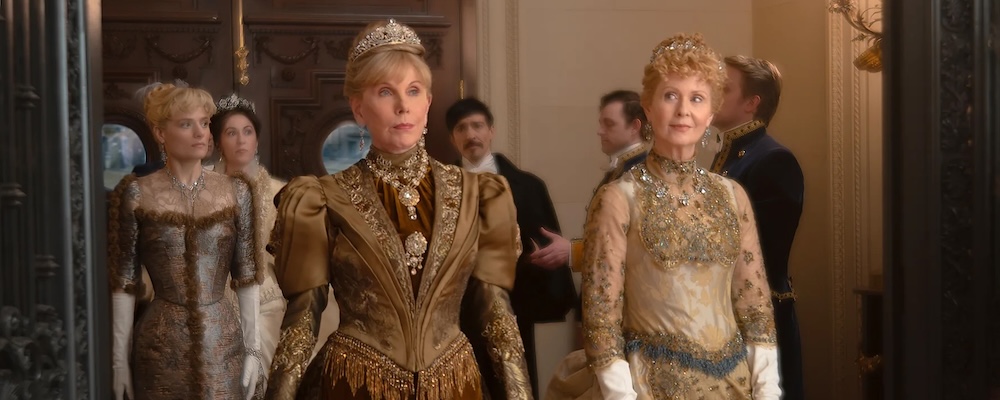
Elsewhere, the familiar social intrigues continue to provide plenty of delicious entertainment. Agnes van Rhijn (Christine Baranski) and her sister Ada (Cynthia Nixon) remain locked in a struggle over their household, while Peggy Scott (Denée Benton) finds her emergence as an important voice in the literary world complicating her relationship with her fiancé. Marian Brook (Louisa Jacobson), meanwhile, is caught in the increasingly painful dilemma of her lingering feelings for Larry Russell (Harry Richardson), a romance that threatens to become one of the season’s most emotionally involving storylines.
Jacobson, whose character has occasionally been overshadowed by the more flamboyant personalities around her, finally gets material that allows Marian to become a genuinely fascinating figure. Her longing for independence, complicated by the secrets she must keep from those closest to her, transforms what might otherwise be a conventional romantic subplot into a story about the suffocating expectations placed upon women in a society that prizes appearances above all else.
Of course, “The Gilded Age” would hardly be itself without its occasional indulgences. The servants continue to provide their own assortment of charming distractions, including John Trotter (Ben Ahlers), whose transition from clockmaker to inventor suggests that the modern kitchen appliance may be just around the corner. Such diversions are part of the series’ appeal, even if they occasionally threaten to undermine the gravity of its more compelling storylines. But the ensemble remains a formidable asset, with Baranski’s icy authority, Coon’s relentless ambition, and Spector’s increasingly tortured performance providing the season with its dramatic backbone. The elaborate costumes, sumptuous production design, and meticulous period detail continue to make the series a visual feast, while the writing finds new ways to explore the contradictions of a society built upon privilege, prejudice, and the relentless pursuit of status.
What makes this fourth season particularly satisfying is its willingness to allow the consequences of previous events to linger. The characters are no longer simply moving from one social triumph to the next; they are beginning to reckon with the personal costs of their ambitions. It is a welcome evolution for a series that has always been entertaining, but has not always felt essential (when compared to “Downton Abbey’s” popularity). The pleasures of “The Gilded Age” remain very much intact, from its wickedly entertaining social warfare to its lavish recreations of a bygone era. But with its fourth season, Fellowes has found a way to make the spectacle feel more consequential. Beneath all those exquisite gowns and perfectly arranged dinner tables, the foundations of this glittering world are beginning to crack. And watching the privileged scramble to keep their lives from falling apart is, as ever, a thoroughly irresistible pleasure.
“The Gilded Age” season four premieres Nov. 1 and airs Sundays at 9 p.m. ET on HBO.