
‘The Further Mis-Adventures of Cliff Booth’: Brad Pitt Has Rugged Charm in Tarantino and Fincher’s Stylishly Rambling Ode to 1970s Los Angeles
Alci Rengifo
The styles of two great filmmakers mesh and clash in “The Further Mis-Adventures of Cliff Booth.” As most of its initial audience will know, the screenplay by Quentin Tarantino is a sequel to his acclaimed 2019 film, “Once Upon a Time… in Hollywood,” a lively ode to 1969 Los Angeles, where the influential director rewrote the history of the Manson murders. Famously allergic to sequels and carefully planning his supposed final film, Tarantino opted out of directing, leaving those duties to David Fincher. Fincher is also highly regarded and influential, but with a vastly different style. Here, his atmospheric moods are applied to Tarantino’s zany, nostalgic, at times rambling writing. The result is a fascinating experience held together by Brad Pitt returning to the role that won him an Oscar.
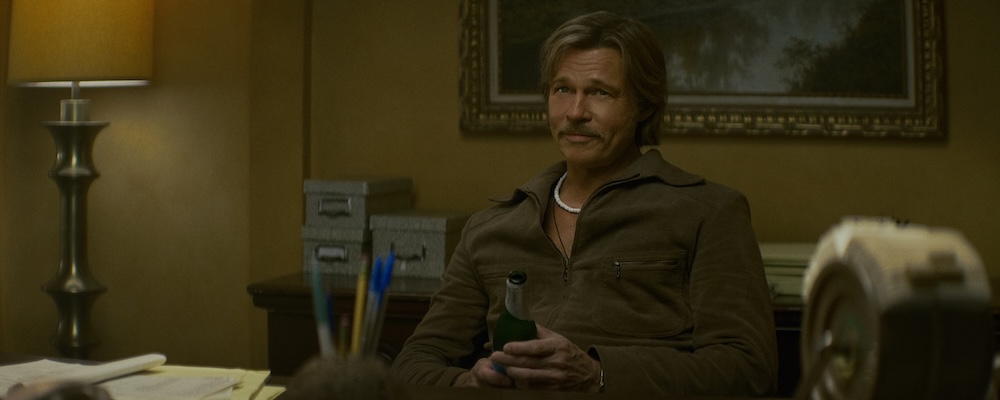
Tarantino’s script is still set in Los Angeles, this time the year is 1977, eight years after stunt double Cliff Booth (Pitt) beat down members of the Manson Family. He is no longer the right hand of actor Rick Dalton (Leonardo DiCaprio, absent in the sequel), who has moved to Italy. These days, Cliff is the projectionist at the New Beverly (owned today by Tarantino), where he also does side gigs like recovering stolen property, such as an Oscar, for a director being blackmailed by hustlers. At home in Marina Del Rey, Cliff lives with his elderly but sharp dad (Peter Weller). The phone rings and Cliff gets called into the office of Karen Crosby (Elizabeth Debicki), an agent and aide to actor Charlie Peters (Scott Caan). Why the actor needs Cliff is a bit of a mystery at first, since he does his own stunts. After prodding Cliff for World War II stories and a twisted urge to know what killing feels like, Charlie comes out with it. He needs protection from a pair of Filipino sibling assassins (Matt Groove and JB Tadena). The actor owes them money after hiring them to kill his wife Toni (Carla Gugino), during a debauched getaway and then calling it off.
Though carrying a hefty Netflix budget and premiering exclusively on IMAX screens, “The Further Mis-Adventures of Cliff Booth” has the feel of a movie probably best enjoyed on the streamer during a slow evening. Sometimes great screenwriters knock one out and leave it on the shelf. In this case, Tarantino simply really liked the character he created and wanted to give him another chapter. Pitt, who has a long relationship with Fincher going back to “Seven,” reportedly approached him to take it on. Even for cinephiles it might be a surprising choice. Fincher’s filmmaking is defined by dark atmosphere and patient tones, as seen in “Gone Girl” or “The Killer.” His wildest moment remains the cult classic “Fight Club.” At first, his style meshes well with Tarantino’s opening, where Cliff projects a riff on Blaxploitation flicks, “Soul Brothers Die Hard!” Fincher gets the rhythm with a hilarious scene featuring Yahya Abdul-Mateen II as “Hot Rod” Harrison. It keeps working when the quirky hustlers blackmailing a director in the closet show up, verbally dueling with Cliff using the wordplay Tarantino is so famous for.
Flashes of violence then lead into the kind of screenplay that can turn into pure indulgence for Tarantino, sometimes verging on rambling. Yet, it’s always entertaining on its own. Cliff talks movies with his dad, before napping and going to his other job as a bartender. Before any kind of plot actually kicks in, the idea is to hang out with this older, rugged night hound. Cliff is like those bouncers or bartenders one meets in big cities whose jobs also define their very identities. He instantly crushes on Karen and admits he is but a simple man, not thinking much beyond the here and now. No longer a stunt double Cliff still likes to get adrenaline kicks by participating in a local demolition derby. These are all mere details the script likes to linger on, devoid of the tighter connections or precision we would find in Fincher’s other work. For the writer, it is probably meant to evoke the nostalgia for his childhood L.A. that obsesses Tarantino so much.
The latter is where the clash of styles begins to be apparent. Never is there the exhilaration of those moments in “Once Upon a Time…in Hollywood” where Tarantino is eager to evoke a bygone city and figures. Not a single scene has the rush of the moment Roman Polanski and Sharon Tate drive to the Playboy Mansion with Deep Purple’s “Hush” on the soundtrack. The moody cinematography by Erik Messerschmidt, a Fincher regular, doesn’t pop with color like Robert Richardson’s work in the first film. Nostalgia was key for the first film because while Cliff and Rick Dalton were entertaining characters, part of the fun was how they were dropped into real history as revised by Tarantino. Charles Manson and his minions wandered in the background like a growing dark cloud heralding the end of the sixties. In “Cliff Booth,” a few conversations allude to “Star Wars” as the hit of the moment, and on TV we see a rather heartbreaking “what if” when a commercial comes on starring Sharon Tate (Margot Robbie).
Purely as a Fincher entry, “Cliff Booth” is at its strongest when the elliptical dialogue tones down and we return to the central plot. Pitt brings a special, personal touch to the role and we sense him, like in the recent “Heart of the Beast,” channeling recent experience into the role. His Cliff knows he will always be a bit of a rebel, but can’t resist wanting to try something honest with the more grounded Karen. They have the chemistry of opposites attracting and Debicki enjoys giving her lines a dry humor. Even with Fincher’s atmospheric lens, there is charm in how Cliff and Karen start making out at a bar but he stops them from going home together, so as to test whether this is genuine or just lust. A flaw in the structure is that Tarantino knows the fans expect his kind of payoffs, so the relationship takes a back seat to a final resolution with the Filipino killers that works hilariously well. Fincher gets to indulge in some of the violence he’s also proficient at, involving bruising punches and alcohol doubling as lighter fluid. And, in QT fashion, we get some good drink recommendations along the way.
“The Further of Mis-Adventures of Cliff Booth” ends as a curiosity tailored mainly for cinephiles. They, along with Tarantino die-hards, are the best audience to sit there for its 143 minutes catching references to the work of both filmmakers. Then there are the excellent performances from everyone, including Scott Caan, looking more like his father the late James Caan, lapping up the zanier parts of Tarantino’s dialogue (including a side story involving a pig). In a way, the immediate appeal is that this is the kind of collaboration movie geeks will ponder about but never think could actually happen. The director of “The Girl With the Dragon Tattoo” shooting a script by the mind behind “Pulp Fiction” is quite a wish list item. Some of it works, some of it doesn’t, but at least they tried.
“The Further Mis-Adventures of Cliff Booth” releases Nov. 25 in IMAX theaters and begins streaming Dec. 23 on Netflix.