
‘The Greatest’ Focuses on the Early Years of Cassius Clay for an Engrossing Portrait of the Man Who Would Become Muhammad Ali
Alci Rengifo
Muhammad Ali was a cultural phenomenon whose influence extended far beyond the boxing ring. The legendary athlete was a fast-talking poet, a provocateur, a political figure, and a man whose extraordinary confidence made him both beloved and controversial. Amazon’s “The Greatest” explores the early years of Ali’s remarkable life, tracing his transformation from Olympic gold medalist Cassius Clay into the heavyweight champion who would forever change the world of sports. The series is a fascinating portrait of a young man discovering that being the greatest boxer in the world does not necessarily mean being treated as an equal.
Created by Ben Watkins, this eight-part limited series begins in 1960, when an 18-year-old Clay (Jaalen Best) wins a gold medal at the Rome Olympics. The story follows his rise through the professional ranks, culminating in his 1964 victory over heavyweight champion Sonny Liston. It is a relatively brief period in Ali’s life, but one filled with personal and professional transformations that would shape his future. Clay’s experiences growing up in Louisville expose the contradictions of a country that celebrates Black athletic achievement while continuing to deny Black Americans basic dignity. After returning from Rome with an Olympic gold medal, Clay is welcomed home as a hero. Yet when he attempts to eat at a luncheonette that sells a burger named in his honor, he is refused service because of his race. The absurdity of this contradiction becomes one of the series’ most powerful observations about American society.
The series makes a convincing case for revisiting a story that has already been told through countless books, documentaries, and films. Jaalen Best delivers a charismatic and layered performance as Clay, capturing the distinctive cadence of his speech, his showmanship, and the unconventional athleticism that made him such a remarkable fighter. Best wisely avoids turning his portrayal into a mere imitation of the legendary boxer. Instead, he reveals a young man whose confidence and ambition are still developing, even as he begins to understand the extraordinary power of his own voice. His performance is particularly effective when Clay’s public bravado gives way to the uncertainty of a young man confronting the world around him.
Clay’s personal awakening is also shaped by his complicated family life. Omari Hardwick brings considerable emotional weight to his portrayal of Cassius Clay Sr., a man who loves his family but struggles with alcoholism and abusive behavior. Dana Gourrier is equally impressive as Odessa “Bird” Clay, whose dignity and resilience provide an emotional anchor for the series. These performances give the story a necessary intimacy, revealing the people and experiences that shaped the young athlete long before he became an international icon. As Clay relocates to Miami to train with Angelo Dundee (Giovanni Ribisi), he begins exploring the teachings of the Nation of Islam. His relationship with Malcolm X (Michael Ealy) becomes an important part of his transformation, forcing him to consider the consequences of embracing a new identity. The series understands that Clay’s eventual decision to become Muhammad Ali is not simply a change of name. It is an assertion of self-determination in a society that has long attempted to define him.
The production also gives considerable attention to Sonny Liston, the fearsome heavyweight champion who becomes Clay’s greatest professional obstacle. Amin Joseph brings a surprising vulnerability to Liston, a man whose reputation as a dangerous criminal obscures the emotional wounds beneath his imposing presence. His relationship with future wife Geraldine provides some of the series’ quieter, more affecting moments. Liston emerges as more than a formidable opponent, becoming another figure whose public image conceals a complicated human being.
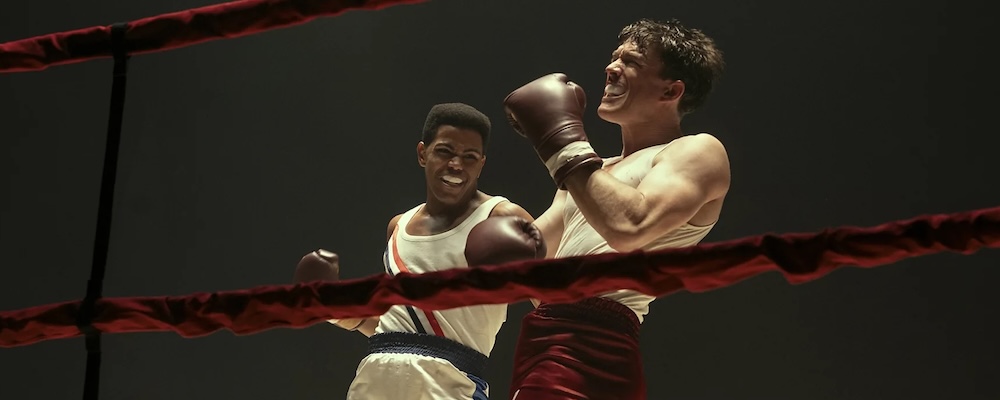
Of course, “The Greatest” would not be complete without its boxing sequences. The fight scenes are impressively choreographed, capturing Clay’s remarkable speed and unconventional technique. His 1963 bout against Henry Cooper is particularly visceral, recreating the devastating left hook that sends Clay to the canvas before his eventual victory by technical knockout. The physicality of these sequences makes the series’ athletic spectacle genuinely exhilarating, capturing Clay’s unique grit and elegance. The man who would become Muhammad Ali had a large personality because his boxing talent was akin to Beethoven’s compositions.
The social messaging can occasionally feel heavy-handed, but the historical context makes the bluntness understandable. The early 1960s were a period of profound racial injustice, and the series appropriately refuses to separate Clay’s athletic achievements from the circumstances that shaped his identity. “The Greatest” might not reveal much that audiences do not already know about Muhammad Ali. Yet its greatest accomplishment is finding the human drama beneath the legend. By examining the years when Cassius Clay began to embrace the power of his voice, the series offers a poignant reminder that greatness is not simply about winning championships. It is about discovering who you are, and having the courage to tell the world.
“The Greatest” begins streaming Nov. 4 on Prime Video.