
Romanian Auteur Cristian Mungiu on Exploring the Janus Face of Prejudice in Acclaimed ‘Fjord’
Alci Rengifo
The films of Romanian director Cristian Mungiu form a unique arc in capturing the social divisions of European society for the last few decades. Many of his characters are confronted with social forces that can range from the state to the personal. Mungiu’s latest, “Fjord,” arrives after winning the prestigious Palme d’Or at this year’s Cannes Film Festival. It is now surely a frontrunner for the Best International Film Oscar. Like Mungiu’s overall body of work, this is a compelling, human portrait where a Norwegian town becomes a microcosm of the wider debates in European society. The director turns the tables on the classic idea of characters suffering persecution. Here, it is a Christian conservative family that comes under intense scrutiny from a community proud of its progressive system.
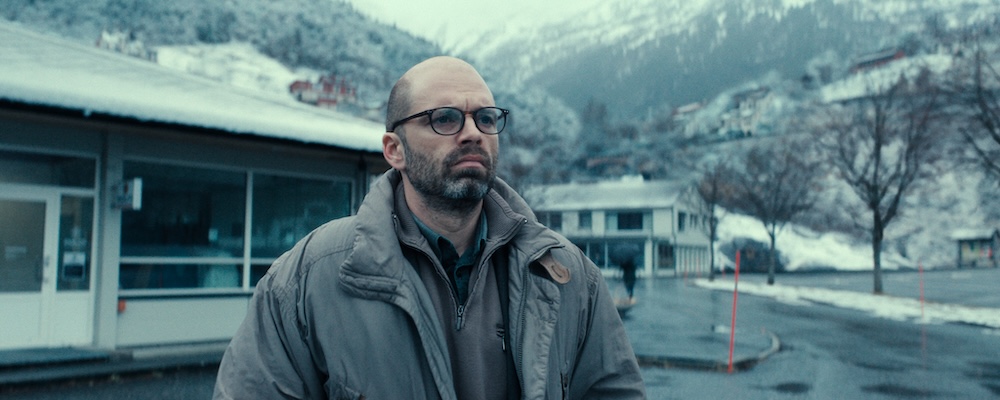
Renate Reinsve, one of the great international actors since her breakthrough in the millennial portrait “The Worst Person in the World,” and Sebastian Stan play Lisbet and Mihai. They are married with five children and raise a home with strict, though not tyrannical, Christian values. Lisbet is Norwegian and speaks the language, while Mihai is Romanian, and so the neighbors sometimes struggle to hide a bias against Eastern Europeans. When one of the teachers at the high school where Mihai works in IT believes she has overheard his teen daughter Ella (Vanessa Ceban) mention abuse at home, Child Services are called in and all the children are removed to temporary foster care as an investigation commences. The question is if any of it is true, or if the couple is simply being targeted by neighbors who scoff at their way of life.
“Fjord” is some of Mungiu’s best work since his 2007 “4 Months, 3 Weeks and 2 Days,” which also won the Palme d’Or. In that film, he followed two young women in 1980s Romania as they endured the process of arranging an illegal abortion. His absorbing 2022 film “R.M.N.,” gazed starkly at the ongoing rise of anti-immigrant paranoia in Europe. With “Fjord,” shot with an almost documentary clarity by cinematographer Tudor Vladimir Panduru, Mungiu challenges us to consider how a society cannot truly be free unless everyone has the freedom to live as they wish, so long as they don’t oppress or intrude in the lives of their neighbors. These are pressing concerns for the humanist director, who spoke with Entertainment Voice about “Fjord” and its wide themes.
You’re addressing through this story so much of what the world is dealing with, not only in Europe but the wider world, including here in the United States as different groups distrust each other. Why choose this angle of a conservative religious family?
I’m always starting from a pre-existing story, and pretty much everything that you see in this film about this family corresponds to the original story which I investigated when I decided to make a film about this. And I talked to this family, I went to Norway, I went to the Scandinavian countries. Little by little, I noticed that there is a pattern. And the pattern concerns conservative families moving to live in Scandinavia — which we all consider, at least in Europe, to be the pole of progressivism. And, you know, you can see clearly the differences of values when these two cultures collide there.
In the case of this family, for example, even if they are Christians, it’s this kind of extreme way in which they interpret religion, which makes them appear as a very extreme way of interpreting Christianity. Because actually, they share the same views of the Norwegian Church, of all the church folks there, but still, everybody is way more liberal. So this is what makes people a little bit more suspicious, because this is considered to be a way more conservative kind of practicing of religion that could eventually allow practices which are very different from those of the progressive Norwegian society.
But as you very well noticed, the film is not about a conflict between Norway and Romania or whatever. It is a conflict between different groups of people not sharing the same view on society, and about how we can find ways of just re-initiating some sort of a dialogue between these groups. Because as you have seen — as you can notice even here in the U.S. — there’s no dialogue. These two groups, the conservatives and the liberals, they hate each other.
Like the characters in this film, and your other films as well, they live in a kind of “cold civil war.”
That’s not a society, sorry. We are not living together any longer. We are not sharing the same history and language. We are just divided based on ideology. And as much as everybody believes his own ideology is the best one, we need to understand that there are as many people in the other bubble believing the same world with us. So, what is the way out? We need to find a way of engaging back into some sort of a dialogue.
Before we return to that broader social, cultural context, the casting is very special because we’ve never seen Sebastian and Renate transform like this. What was that relationship like between the three of you?
I like it when I manage to cast actors in a very different kind of role than what they did before. And this is coming from my pattern, my way of filmmaking in which, ideally, you should focus on the story. You should understand that this could happen to you, to anybody close to you. I use the material of everyday life, and therefore I don’t want the story to be polluted by the, you know, the iconic face of a superhero or the very modern, sophisticated lady that Renate really is. So I told them from the beginning that they need to adapt to the story and really try to represent very humbly these characters that they were portraying. And they understood that they couldn’t pollute this interpretation with their own perspectives about the values of today. This is not what an actor, and not me as a director, should do.
Sebastian was very, you know, generous,not only to adapt to my style — which is a bit special because I’m just shooting master shots — but also to let himself be remodeled into the way he looks in the film. I’m happy when people tell me that, “Well, actually we hadn’t recognized Sebastian in the film for a long while,” because I wanted to cast him for his talent and his capacity for doing these very strong dramatic characters, and not his looks, which are those of a beautiful-looking man with a lot of fans.
I met Renate not knowing which part in the film she was going to interpret. So we read for both parts, and finally she felt closer not to the woman sharing the same values with her in society, but intuitively to the mother. So, okay, very good, let’s study the character of the mother. See why she is driven by these ideas and try to portray this. And I think she did it brilliantly because she has this lovely charisma, and she’s sharing a lot of feelings and this kind of humbleness that she’s experiencing, and this comes across on screen.
With everything going on in our continent and in Europe, what do you have coming up next after “Fjord?” Do you want to keep exploring these themes, like in “R.M.N.?” Your films kind of capture the trajectory of Europe over the last 20 years. What is inspiring you for the next journey?
For now, what’s important for me is to make people understand that “R.M.N.” and “Fjord,” represent this concern that I’m having towards the direction in which our Western society is heading. This is a valid concern for Europe, but it’s valid for the U.S. as well, I have to say. We see this radicalization. We see this idea that everybody seems to be believing that there’s just one truth belonging to them, and the other side of the society is fully brainwashed. This is the difference between “R.M.N.” and “Fjord.” In “R.M.N.,” I was analyzing what happens when, you know, some foreigners arrive into a very conservative society that behaves badly towards them. But you know, I took the risk to analyze what happens when the progressive part of a society is the majority and some conservatives come there, and it doesn’t seem to be such a big difference. We would expect more tolerance, more inclusion, and this humble idea that, you know, it’s good to practice this humility that maybe you are not always right, and to double-check your opinions, and to engage into a dialogue with the others, to try to reconstruct a society inclusive for everybody.
Do you have faith in cinema then, as a tool for positive change?
We need help from you to spread this idea that it’s okay to make a film which, well, you know, it’s not always a crowd-pleaser, but it’s responsible. It makes you think about things. This is what cinema should also do.
“Fjord” releases Oct. 9 in theaters nationwide.