
‘Godzilla Minus Zero’: Takashi Yamazaki Continues His Riveting Revival of Kaiju Classic With a Grander Spectacle of War and Humanity
Alci Rengifo
Godzilla was always more than just a massive monstrosity. The most famous of all kaiju was created in 1954 as an artistic response to the shadow of the nuclear age and Japan’s trauma following Hiroshima. Takashi Yamazaki continues his stunning return to the franchise’s roots with “Godzilla Minus Zero,” a true popcorn spectacle where the human element is as grand as the monsters. It is a direct sequel to Yamazaki’s Oscar-winning “Godzilla Minus One,” which grabbed audiences with its blend of action and historical drama. What could have just been another special effects fest turned out to be a haunted reflection on a society’s war guilt. “Minus Zero” stays in that spirit as it expands into the kind of popcorn experience that shames American blockbusters.
Set in 1949, the movie opens with the sudden appearance in Matsumoto of a new ferocious kaiju fans will recognize as the dragon-like King Ghidorah. After the beast leaves a trail of destruction the government calls in Dr. Noda (Hidetaka Yoshioka), the former weapons developer and now resident kaiju expert. While the U.S. presence is strong and military officials keep a close eye, for now Japan is expected to tackle this new threat somewhat alone. Noda also works with meteorologist Makoto Aoyama (Masami Nagasawa) and biologist Kanji Murakami (Min Tanaka), a survivor of Hiroshima. Out at sea, Godzilla also remerges despite having been believed dead at the end of “Minus One.” Meanwhile, former kamikaze pilot Kōichi Shikishima (Ryunosuke Kamiki) is still around and married to Noriko (Minami Hamabe), who you will recall survived a Godzilla attack on Ginza in the last film. She wears an eyepatch that conceals more than a wound. Together they raise adopted daughter Akiko (Sae Nagatani). As Noda struggles to find a way to defeat Ghidorah, which turns out to have crash-landed on a meteorite, it seems the only viable option will be to lure it into a battle with Godzilla.
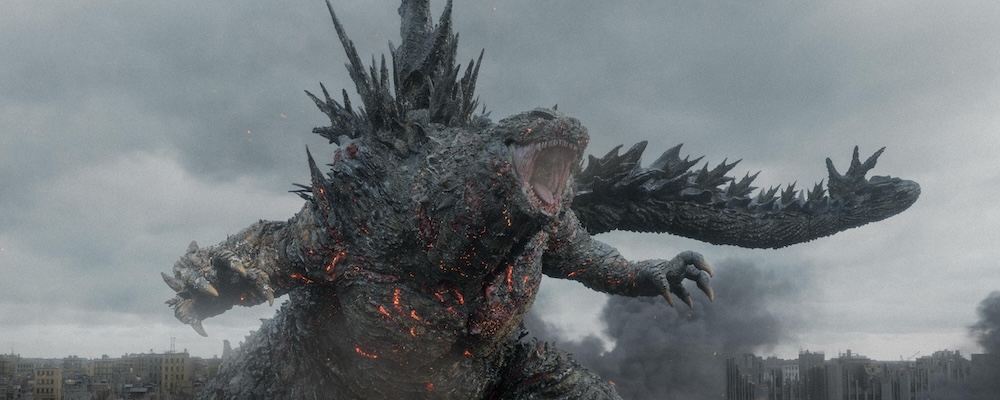
If “Minus One” opened by patiently establishing its world and characters, “Minus Zero” roars in with Ghidorah’s spectacular first appearance, scored to Naoki Satō’s evocative music. Yamazaki’s sense of scale is awe-inspiring. With cinematographer Kōzō Shibasaki’s touch there is the rich look of a period film, but also a sense of scale when the kaijus appear. Excitement also turns into near-terror when Ghidorah obliterates a neighborhood, with electric beams that levitate and suspend buildings and people like a shockwave. Godzilla’s own reappearance is a thrilling sequence that would make James Cameron proud. Yamazaki and his team again set an example for how to do spectacle with pure cinematic craft, telling the story via the effects without overpowering the screen with CGI fireworks. In the States, the atomic lizard is typically introduced for some elongated action sequence, while here, he emerges before the film cuts back to the human story.
Going back to 2016’s “Shin Godzilla,” Japanese cinema has been reclaiming the essence of this franchise. Before it became known for its colorful kaiju battles and entries ranging from fun to absurd, “Godzilla” was meant to evoke the terror of the nuclear bomb. Director Ishirō Honda purposefully evoked images inspired by Hiroshima and Nagasaki in the 1954 original. The script was reportedly inspired by the Castle Bravo hydrogen bomb test the U.S. carried out in the Pacific, with dangerous results. Yamazaki returns to that tradition by making “Minus Zero” into a rather potent statement on the psychological aftershocks of World War II. The ray that shoots from Godzilla erupts into a mushroom-like explosion. Ghidorah’s rampages clearly maim and kill civilians, and the death toll weighs on Noda. Murakami is even more of an explicit symbol. He watched his family burn alive at Hiroshima and has plotted a diabolical scheme to get revenge on the United States. Noda must decide how far to go to stop Ghidorah using Godzilla, but Shikishima and Noriko are pulled in with their own tough decisions to make. She has a particular connection now to Godzilla (as hinted at in the final moments of “Minus One”), which might prove useful but at what cost?
Such a unique serving of sincere acting which then leads to some of the year’s great action scenes. The kaiju battles in “Minus Zero” are loud and brilliant. They feature a scope and clarity missing in the recent American movies where the editing gets so chaotic. Here, Godzilla and Ghidorah battle over ruined cities, tearing limbs and firing beams at each other, but in images that are truly epic. Other notable sequences include an aerial chase of Ghidorah by fighter pilots trying to help pull off a plan by Noda, done with visceral suspense. You can almost term the structure of the action scenes as exquisite, something you can’t say about recent stateside CGI blowouts.
It would all just be impressive technical skill if the humans were not so engaging. We genuinely care for everyone’s motivations. Noda seeks to banish the inner demons of having made weapons during the war for a hopeless cause. Murakami has been driven nearly mad by having witnessed nuclear terror in person, and in a sense symbolizes the human leftovers of all conflicts. Who have we left behind the ruins of current wars, and how will they come back to haunt us? Five-year-old Akiko becomes another innocent bystander caught in the cataclysms of others, when Shikishima and Noriko wonder if it would be best to leave her behind in the care of someone else. This leads to a wrenching emotional scene that almost makes you forget we’re waiting for the kaijus. “Godzilla Minus Zero” becomes more than another monster movie. It is glorious pop art about the human condition, which produces the most frightening monsters of all.
“Godzilla Minus Zero” releases Nov. 6 in theaters nationwide.