
‘Blade Runner 2099’: Michelle Yeoh and Hunter Schafer Enter a Visually Masterful World as a Classic Franchise Looks Further Into the Future
Alci Rengifo
Because we are living in a time when artificial intelligence is becoming increasingly integrated into everyday human life, science fiction has remained obsessed with the now very real premise that the machines we create will surpass us. There is something particularly unsettling about the idea that humanity could find itself competing with its own inventions for a place in this world. Amazon’s “Blade Runner 2099” takes our collective anxiety in an intriguing direction, imagining a future in which the artificial beings once treated as an inferior species have taken control. Unfortunately, despite its impressive visual atmosphere and the presence of two compelling actors, this continuation of a legendary science-fiction franchise struggles to give its philosophical ambitions the emotional substance they deserve.
Set approximately 80 years after the events of Ridley Scott’s original “Blade Runner” and half a century after Denis Villeneuve’s “Blade Runner 2049,” this series by Silka Luisa introduces a Los Angeles that has undergone a dramatic transformation. Following a series of devastating conflicts, replicants have emerged victorious in their struggle against humanity. The balance of power has shifted, with humans now occupying the disadvantaged position once reserved for the synthetic beings created to serve them. Those who resist the new order face persecution or are dispatched to perform brutal labor beyond Earth.
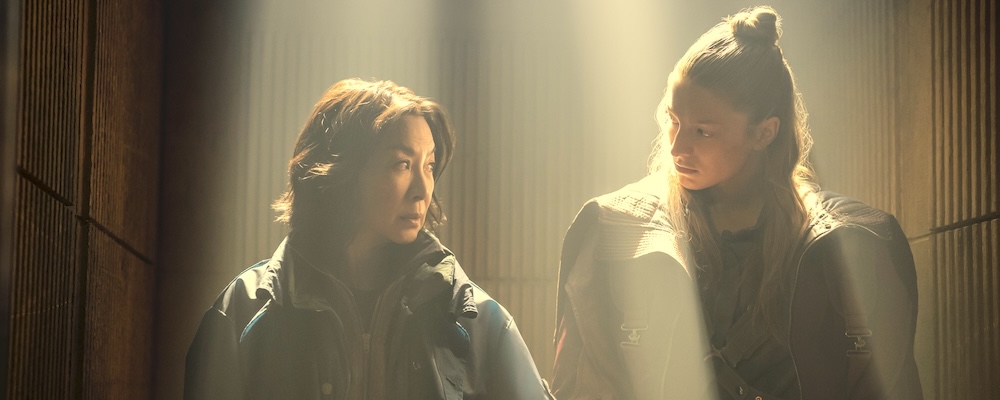
At the center of this world are two women whose circumstances bring them together under unusual circumstances. Olwen (Michelle Yeoh) is a replicant working as a Blade Runner, with only eight days remaining before reaching the end of her predetermined lifespan. Her investigation into the disappearance of fellow officer Marek (Johnny Harris) introduces her to Cora (Hunter Schafer), a human who has assumed the identity of a replicant and infiltrated the police department. Cora hopes to obtain a mysterious artifact that she can exchange with human rebels for passage to Mexico City, reportedly the last remaining human-controlled enclave. Their separate objectives eventually become intertwined, setting the stage for a partnership that should provide this series with its most interesting dramatic possibilities.
The premise is certainly promising, particularly because it reverses the traditional relationship between humans and replicants. In the earlier films, the artificial beings were the outsiders struggling to establish their right to exist. Here, humanity has inherited that same vulnerability. The reversal offers an opportunity to examine how easily societies can reproduce the injustices they once condemned when political power changes hands. Yet “Blade Runner 2099” never explores these ideas with quite enough complexity. Its characters frequently discuss identity, mortality and the meaning of existence, but the writing rarely allows these conversations to develop into genuinely provocative examinations of the world around them.
The series also retains the atmospheric qualities that made the original films so influential. Los Angeles remains a sprawling collection of deteriorating buildings, neon illumination and overcrowded streets, where the remnants of an earlier civilization exist beneath oppressive clouds of pollution. Leopold Ross provides a mournful jazz score that complements the city’s loneliness, while the production design recreates the grimy futuristic environments associated with Scott’s original vision. There is a recognizable visual language here, one that fans of the franchise will immediately appreciate. Yet the familiarity eventually becomes something of a limitation. Rather than expanding this universe with a distinctive identity, the production too frequently settles for recreating images and sensations that have already been explored more successfully elsewhere.
A particularly fascinating sequence takes Olwen and Cora into an establishment where replicants indulge in artificial experiences of pregnancy and parenthood. The mechanical babies and simulated pregnancies reveal a population attempting to experience something that its creators deliberately denied it. The proprietor argues that replicants should stop measuring their existence against human capabilities and embrace what they might become independently. It is one of the season’s most interesting philosophical observations, suggesting that the pursuit of humanity might itself be a form of imprisonment.
Unfortunately, the narrative rarely develops such moments into something more substantial. Much of the eight-episode season revolves around searching for missing individuals, locating mysterious objects, and uncovering secrets connected to the protagonists’ respective histories. There is an abundance of movement, but surprisingly little forward momentum. The deliberate pacing occasionally creates an appropriately haunting atmosphere, yet other stretches feel unnecessarily prolonged, as though a feature-length story has been expanded without sufficient dramatic material to justify the additional time.
The performances provide some welcome relief. Yeoh brings considerable authority to Olwen, communicating the character’s anxiety about mortality through subtle expressions and gestures. Her encounter with a goat becomes an unexpectedly touching reminder of the experiences that can make an otherwise ordinary existence meaningful. Schafer also contributes an appealing vulnerability to Cora, conveying the desperation of someone forced to conceal her identity simply to survive. Their contrasting personalities suggest a potentially rewarding relationship, although the writing never gives either character enough psychological depth to make their journeys entirely satisfying.
The supporting cast fares less successfully. Cora’s brother Elias (Lewis Gribben), human ally Bebeto (Dimitri Abold), and Greta (Katelyn Rose Downey), a young woman forced into working for the police, all contribute to the larger narrative without becoming particularly memorable individuals. Their circumstances suggest compelling stories about oppression and survival, but these possibilities remain largely unexplored.
An original producer on the franchise was Ridley Scott, whose fascination with artificial intelligence and humanity’s relationship with its creations continues to influence contemporary science fiction. “Blade Runner 2099” certainly understands the visual appeal of that legacy, but it struggles to reproduce the intellectual curiosity that made the earlier films so enduring. The central questions remain fascinating, yet the answers are frustratingly superficial.
Science fiction of this kind is particularly valuable when it challenges audiences to reconsider their own relationship with technology and the future. “Blade Runner 2099” has the ingredients for an ambitious examination of existence, identity and the consequences of technological progress. Yet, despite Yeoh and Schafer’s efforts, its impressive exterior cannot entirely compensate for the absence of meaningful emotional connections. This is a world that looks convincingly alive but too often feels strangely mechanical. In a franchise built around the possibility that artificial beings might possess genuine souls, that is a rather unfortunate contradiction.
“Blade Runner 2099” begins streaming Nov. 25 on Prime Video.