
Lee Chang-dong’s ‘Possible Love’ Masterfully Examines Parasitic Exploitation With a Magnificent Ensemble
Tony Sokol
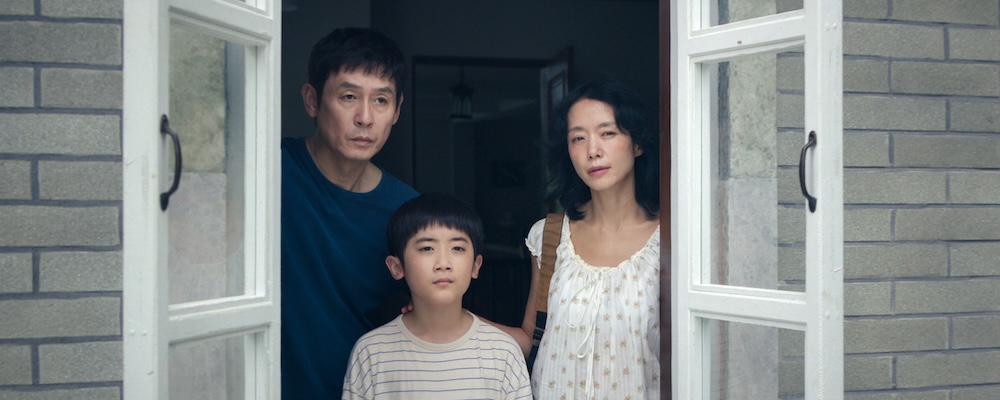
Class wars play out on several battlefields in South Korean auteur Lee Chang-dong’s “Possible Love.” Inequality in the workplace and at home are met with resistance, protest, and bullied acceptance. Ho-seok (Sul Kyung-gu) was not only fired from his factory job during a strike that went violent, he was beaten unconscious, repeatedly, by the government police sent in to protect the oppressive corporation. His wife Mi-ok (Jeon Do-yeon) participated in the front lines of the protest, watching a beautiful show of community fall into the chaos of battered bodies.
The couple is now struggling. Ho-seok is a low paid welder. He suppresses his anger until it comes out in violence, medicates his pain with alcohol, and refuses to consider therapy for the post-traumatic effects of the hospitalization, arrest, and jail time he suffered in the union busting. Mi-ok works at a small paper plant, and keeps an affectionate eye on their 10-year-old son Cheol (Jung Seol). She presents an upbeat, imaginative, and playful exterior, but asserts unblemished truths when pressed. Workers who still have their jobs at the large factory, Mi-ok explains, are called “the living.” The ones who lost theirs are known as “the dead.”
The film, which Lee co-wrote with Oh Jung-mi, was inspired by the 77-day 2009 SsangYong Motors metal workers’ union strike, which was brutally crushed by Korean police. The job losses resulted in multiple suicides. “Possible Love” begins at the funeral of one of Ho-seok’s co-workers who was fired and took his life. Cho Yeo-jeong, who played the matriarch in the trendsetting class-consciousness thriller “Parasite,” plays Ye-ji, the director of an independent documentary covering the aftermath. Independent, as her wealthy husband Sang-woo (Zo In-sung) explains, means “made without money.” Mi-ok meets Ye-ji at a reception on corporate restructuring and job loss. The director wants the couple to appear in the labor film. Mi-ok agrees, but can’t speak for her husband.
The two become friendly enough to share cigarettes and call each other by first names. Soon Mi-ok and Ho-seok accept invites to fancy restaurants and Sang-yu’s spacious vacation house with a private beach. Privately, condescension flows like soju. Ye-ji and Sang-woo are aware of their inherent differences, if only one admits it. Sang-woo believes his wife is “method acting,” while Ye-ji firmly holds to the public belief she is “trying to love” their new friends, as she loves all the subjects of her documentaries. After all, she got the idea for the film after being told of some invisible staff which keeps her favorite deluxe hotel running.
Ye-ji’s coverage becomes increasingly intrusive. The moment an uncomfortable revelation appears, so does the tripod. Secret movements are captured by the roving lens of the documentarian, and mirrored in flashback sequences of Ho-seok and Mi-ok’s past, which is sweet and complicated. The young and athletic Ho-seok was an unlikely romantic. Mi-ok’s memory is poetic. Her childhood recollections are filled with shimmering sunlight on car wash hoses, and the dire warnings not to touch them. Cinematographer Kim Ji-yong’s also records the forward narrative on held-held cameras, which occasionally misdirects perspectives, adding to tensions already simmering, and the increased vulnerability of personal contact.
Sul unearths a man who lost more than a job, but an identity. Initially, Ho-seok is barely able to express himself verbally. He walks out of support groups, screams at nature in increasingly difficult attempts to reluctantly hold himself together. Ho-seok wishes to give up, and Sul expresses this with his whole body. Ye-ji sees it in his “sad eyes,” which she wants to capture on film. She knows Ho-seok should be the center of the piece.
Before cursing the very word solidarity, Ho-seok loved his job enough to fight for it. He sees the labor dispute as a vicious corporate attack, and still gets sideswiped. Sul bristles with an anguished desperation for some unreachable conclusion but unravels as Ho-seok articulates it. His range of control and loss of self is remarkable, especially as a possible love continues to come through for the family Ho-Seok failed.
Jeon brings an exhaustive life to Mi-ok, swinging between childlike flights of footloose fancy and an unflinching demand for grounding. She never hides the sorrows haunting her, and appreciates the temporary opulence with a mischievous innocence. Mi-ok helpfully mentions how the fashionable clothes Ye-ji wears might alienate the flashy documentarian from the protestors fighting to get a pay day. Mi-ok also notes how Ye-ji’s films are funded by the state, taking money from more deserving artists, when she could get the money from her rich husband. Ye-ji puts the idea of another unionization in Mi-ok’s mind, in an environment proven to be closed to unionization. It could make for good footage.
Every performance is exquisitely layered. We are deeply invested in all four characters’ lives. As Sang-woo, Zo exudes the confident privilege of inherited money from the moment he flashes his Porsche headlights on Mi-ok’s dropped wedding ring until the victory swim which further marks his territory. Sang-woo is something of a vulture, circling over prey he’s already taken down. A short living room bout of Taekwondo physically displays the disparity with offhanded humiliation. Ye-ji appears open, but it becomes increasingly apparent this is a reciprocal arrangement. Details are conditional. Trust is a bargaining tool for camera time.
“Possible Love” is Lee’s first feature in eight years, and is a moving return that hits as vastly political and intimately personal. The horrific irony of the true sociological brutality is told very subtly. The circular exploitation at the heart of the personal class war is insidious and frustrating. But broken couples go on. Filled with dense symbolism and beautiful imagery, the film is angry, but measured; regretful but hopeful. It is not impossible for love to survive the worst life can throw, only to get compensation.
“Possible Love” begins streaming Nov. 6 on Netflix.